By Damian Antommarchi | September 24, 2026 | 12 min read
Average retail price per gram of flower, from state regulators’ own sales data.
Latest available regulator data; reporting periods differ by market. This shows scale and market maturity, not an apples-to-apples ranking.
How we built this: New York is our calculation from the Office of Cannabis Management’s 2024 average prices by package size ($44 eighth, $196 ounce), weighted by each size’s share of flower sales. It is the most recent official figure; New York has not published a newer per-gram price. California is the average packaged eighth ($21.46) in the Department of Cannabis Control’s price-per-unit data, divided by 3.5; eighths cost more per gram than bulk sizes, so this runs high for California. Michigan is the Cannabis Regulatory Agency’s August 2026 average adult-use ounce ($60.33) divided by 28.35. Massachusetts is the Cannabis Control Commission’s June 2026 adult-use average. Puerto Rico is the 2025 average price per gram of flower recorded in the island’s BioTrack tracking system, according to the 2026 market study prepared for Puerto Rico’s medical cannabis regulator. New York is 2024, Puerto Rico is 2025 and the others are 2026, and product mixes differ.
If you’ve bought flower in New York and then bought it anywhere else, you already know the feeling. You walk into a licensed shop in Manhattan, pick a decent eighth, and the register says forty-something dollars. Your cousin in L.A. is often paying about half that. Your people back on the island are texting you pictures of deals that make your wallet hurt.
The numbers back up the feeling. In New York’s most recent official statewide price data, the average legal eighth sold for $44 in 2024. California’s regulators put the average packaged eighth at about $21.46 this year, and a menu survey by Ganja.com had the Los Angeles median around $22 this month. Those figures come from different years, because New York hasn’t published a newer statewide eighth price. But the state’s own data shows New York prices have fallen only about 15% since early 2024, nowhere near enough to close that gap. On the East Coast, the Lit Alerts eighth index had New York back in first place in August at $37.16, while Massachusetts held at about $23.
So what’s going on? It isn’t one villain. It’s a stack of costs and delays, some at the register and a lot more before the product ever reaches the store.
We pulled live flower menus from licensed dispensaries and sorted them by tier so we’re not comparing a bargain eighth to a top-shelf jar. This is a spot check of three stores, not an index. Three stores can’t represent New York City or Puerto Rico as a whole. Treat it as a reality test for the state data above.
| Store | Value 3.5g | Mid 3.5g | Premium 3.5g | Bulk |
|---|---|---|---|---|
| Housing Works Cannabis Co.Manhattan, checked Sept. 24 | $3022–33% THC | $35–4427–31% THC | $5029% THC | $100 / 14g |
| CannadreamsHell's Kitchen, store's Sept. 13 menu | $30–62 range, tax included | $99–180 / oz | ||
| FloraSan Juan, PR, checked Sept. 24 | $3.92–4.42/gvalue buds and smalls, 26–30% THC | $22.42pre-packed, 28% THC | $8.96–10/g≈ $31–35 per 3.5g | — |
Housing Works’ online menu doesn’t say whether tax is included. Flora’s odd-cent prices suggest Puerto Rico’s 11.5% sales tax is already built in. THC percentages are as listed by each store, and none disclosed grow method. Promotions (first-visit discounts at both Flora and Housing Works) are excluded. What these three menus show: shelf to shelf, a comparable eighth at Flora ran roughly a third to a half cheaper than at the two Manhattan stores. That’s a big gap, but not the 4x the statewide averages suggest. Puerto Rico’s very low average is likely pulled down by cheap bulk, smalls and shake; interviewees in the island’s market study said shake and trim are widely used.
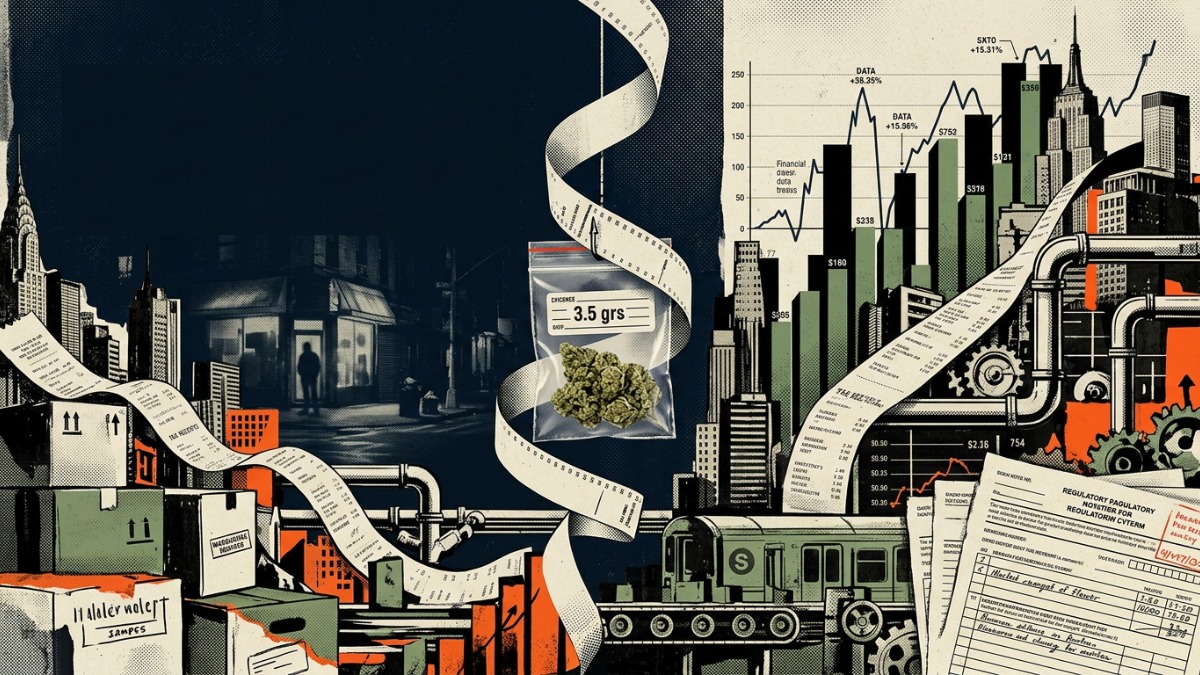
1. The tax gets you twice
New York taxes legal cannabis at two different points. When a distributor sells to a dispensary, the distributor owes the state 9% of that wholesale price. You never see that 9% on a receipt. It’s an upstream cost, and it can end up baked into the shelf price. Then, when you pay at the counter, a 13% retail tax is added: 9% to the state and 4% to the local government. Both pieces of the 13% are figured on the same pre-tax price, so they simply add up.
New York used to tax by THC potency at the wholesale level, charging distributors per milligram. That system ended in June 2024 and was replaced with the flat 9% distributor tax, which made compliance simpler but didn’t make weed cheaper for you.
Checkout math: a $40 eighth in NYC
*The separate 9% distributor tax is not added here. It was paid upstream and may already be reflected in the $40. Some NYC shops post tax-included prices, so check the menu.
But taxes alone don’t explain the gap. California has one of the heavier cannabis tax structures in the country and still sells eighths for about half of New York’s average. Michigan added a 24% wholesale excise tax on Jan. 1, 2026, charged on the wholesale price when a grower or processor first sells adult-use product to a retailer, on top of its existing 10% retail excise and 6% sales tax. The tax is still being challenged in court, and Michigan still has some of the cheapest flower in America. The bigger story starts before the store.
California and Michigan are drowning in flower. California’s licensed farms produced roughly 1.4 million pounds in 2024, according to data from the state’s Department of Cannabis Control. Michigan ended 2025 with more than 1.4 million pounds of flower sitting at processors. When there’s that much product, wholesale prices collapse. Colorado’s average wholesale price for a pound of bud fell from over $2,000 in 2015 to about $658 by late 2024, according to figures New York’s own regulators cited. Nationally, the Cannabis Benchmarks spot index has hovered a little above $1,000 a pound this year.
New York’s supply story is different, and more complicated than “not enough weed.” The state actually had gluts. Cultivators reported nearly 200,000 pounds of biomass in inventory in November 2024, down from a peak of 240,000. But about 45% of licensed cultivators and microbusinesses grew outdoors, while New York shoppers, used to indoor-grown illicit product, want indoor flower. Until 2025, the big medical companies were the only licensees growing indoors at scale. The state licensed about 50 new indoor growers in 2024 and in June 2025 let existing cultivators add indoor canopy, but that supply is still ramping up. So the problem has been the wrong mix of product at the wrong time, not simply too little of it.
That shows up in wholesale prices. LeafLink’s 2026 wholesale pricing guide, built from billions of dollars in 2025 transactions across 18 markets, singled out New York and Alaska as markets that command higher wholesale pricing, while Oklahoma, Michigan and Oregon competed hard on price. New York doesn’t publish a wholesale price per pound, and the private indexes that track it are subscriber-only, so we can’t give you an exact number. What we can say is that a good part of New York’s retail price problem is already baked in when the product leaves the farm.
And here’s the key: New York can’t fix that by buying cheap flower from California. Because cannabis is still federally illegal for adult use, it can’t legally cross state lines. Every eighth sold in a New York dispensary has to be grown here, by the state’s roughly 250 active licensed cultivators. Puerto Rico works the same way. Even New York’s regulators have noted that federal rescheduling could eventually open the door to interstate commerce, but that door is closed today.
New York’s store count has exploded: 34 legal dispensaries at the end of 2023, 261 at the end of 2024, and 705 as of the Office of Cannabis Management’s August board meeting. New York City had 214 of them by late 2025. But at the end of 2024, New York had the most people per dispensary of any major legal market in the country, about 72,000 residents per store. Even with 705 open today, that works out to roughly 28,000 New Yorkers per shop. The state’s own comparison puts Michigan near 10,000 and Massachusetts near 16,000.
Add NYC commercial rent, security, payroll and compliance costs, and a Manhattan dispensary simply has more to cover on every sale. There’s also a policy brake on price wars: advertising discounts has been prohibited across New York’s supply chain, and in 2025 the state’s regulators recommended rules that would limit the kinds of deals that fuel price-based competition.
Then there’s the unlicensed market. Unlicensed shops operate outside New York’s regulated testing, tracking and cannabis-tax system, which lets some of them undercut licensed dispensaries. We couldn’t find a state-published lab comparison of licensed and unlicensed products. A 2023 study commissioned by a state medical cannabis trade group tested 40 products from 20 unlicensed NYC shops and found about 40% failed at least one contamination test. For context, 97% of licensed adult-use product lots passed state testing in 2025 through November, and the ones that failed were kept off shelves, though the licensed system has had its own problems, including a February 2026 recall of 55 lots after a state-licensed lab reported unreliable mold results.
4. The federal tax penalty
There’s one more cost you never see on the receipt. A federal tax rule known as Section 280E blocks businesses that traffic in Schedule I or II drugs from deducting normal expenses like rent and payroll. For years that meant legal cannabis businesses paid federal income tax on something closer to their gross profit than their real profit. New York State and New York City have decoupled their own taxes from 280E, but the federal hit remains.
That changed partly this spring. On April 23, 2026, the Justice Department issued an order moving FDA-approved marijuana products and marijuana subject to a qualifying state medical license into Schedule III. On September 9, a federal appeals court declined to halt it. Adult-use marijuana, including everything sold in New York’s recreational dispensaries, is still Schedule I. The DEA held hearings on broader rescheduling from June 29 to July 15, and as of mid-September no decision had been issued.
Even for medical businesses, the relief isn’t settled. The order didn’t define what counts as a qualifying state-licensed medical business, legal analysts say questions remain about U.S. territories, and as of September the IRS still hadn’t issued the 280E guidance Treasury promised in April. So the fair summary is this: New York’s rec shops are clearly still under 280E, and medical operators may be getting out from under it, but nobody has the final paperwork yet.
The $45 eighth: where does the money go?
You pay
$45.20
13% retail tax to state and city
−$5.20
Store keeps, before any costs
$40.00
Wholesale cost of the eighth, including the upstream 9% distributor tax
Illustrative estimate based on industry gross-margin benchmarks — not reported NYC wholesale pricing.
~$18–24
Estimated gross margin before operating expenses
Illustrative estimate, same basis as above.
~$16–22
That margin still has to cover rent, payroll, insurance, security, compliance, banking and payment costs, inventory losses and federal taxes. What’s left after that varies widely from store to store, and New York dispensaries don’t publish it.
The wholesale and gross-margin ranges assume the 40–55% dispensary gross margins that cannabis finance advisers commonly cite. They are not New York–specific figures, and we did not see any New York invoices. We don’t estimate final store profit because no New York–specific financial data supports one.
So are New York dispensaries getting rich? Revenue alone can’t answer that. The state’s own data shows a very lopsided market: as of November 2025, the top 10 stores in New York made 29% of all legal sales, and the average store was running at about $3.8 million a year. At the other end, the state’s 2024 market report found more than a third of established stores running below $2 million a year, a level regulators said is likely not sustainable in the highest-cost regions. The state has also warned that falling prices are likely to squeeze margins further. A high shelf price doesn’t automatically mean a high profit, and the numbers suggest many shops are closer to struggling than to cashing in.
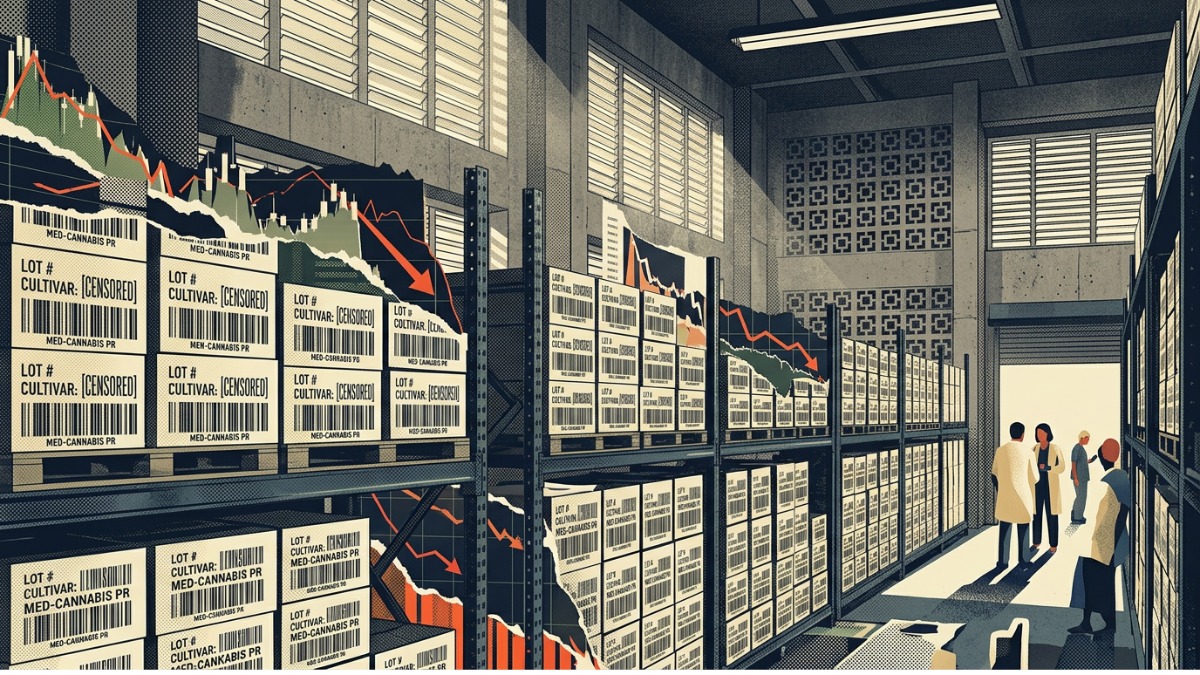
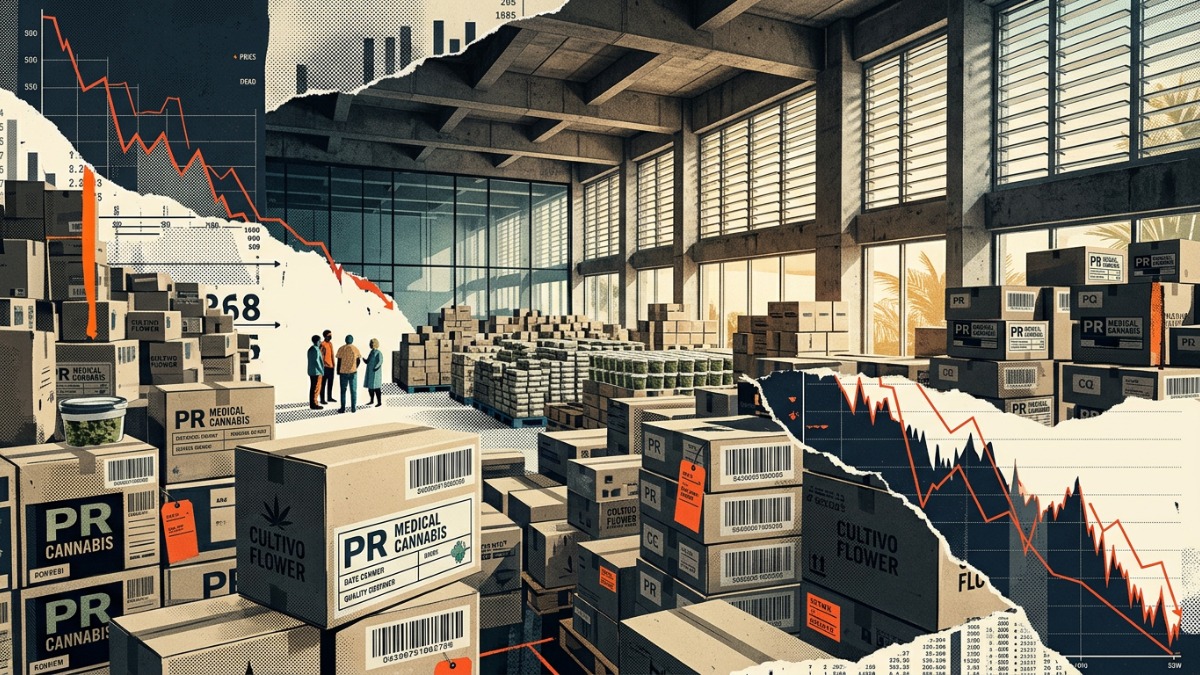
If you’ve been to San Juan lately, you’ve seen the deals, and the data backs it up. According to the 2026 market study prepared for Puerto Rico’s medical cannabis regulator, the Junta Reglamentadora de Cannabis Medicinal, the average price per gram of flower fell from $8.91 in 2020 to $2.73 in 2025, a 69% drop. That’s in Michigan territory, the cheapest legal market in the States.
Way more weed than patients. According to the same study, Puerto Rico’s 68 active cultivators produced about 113 million grams of cannabis in 2025, while patients bought the equivalent of about 86 million. The study puts the surplus at roughly 27 million grams and says licensed growing space exceeds what patients need by about 31%. Industry members interviewed for the study in 2024 said the wholesale price of a pound had fallen below the cost of producing it, and many expected most small operators to eventually go under.
A small pool of legal customers. Puerto Rico is medical-only, so the real customer base isn’t the island’s population. It’s registered patients: about 108,000 active patients for 305 dispensaries in April 2026, or roughly 354 patients per dispensary. Patient numbers peaked near 125,000 in 2022 and were around 110,500 in June. New York has no patient registry for adult use, so we can’t count its customers the same way. As a rough illustration only: if about one in seven adult New Yorkers uses cannabis in a given month (the state’s measured rate is 14.7%), that’s roughly 3,000 estimated past-month consumers per New York dispensary. These are different measures, registered patients versus estimated consumers, so they aren’t equivalent customer counts. We use them only to show how much thinner the pool of legal buyers is for each Puerto Rico store.
The nuance. Store crowding alone doesn’t explain it. The same study found flower prices were basically the same whether a town had few dispensaries or many, around $2.59 to $2.74 a gram. Its numbers point to the flood of product from growers as the bigger driver, and cheaper product has pushed patients to buy more: the study found consumption per patient rose more than 50% as prices fell.
One simple tax. Medical cannabis in Puerto Rico pays the regular 11.5% sales tax (IVU), with no separate cannabis excise at the counter.
Not because of the federal change. Puerto Rico’s price collapse happened from 2020 to 2025, well before April’s Schedule III order. Whether island operators get 280E relief is still an open legal question.
The catch. You need a medical card to buy, whether it’s from your home state or a temporary one from an island telehealth clinic. Smoking flower isn’t an approved method under the program, which is built around vaporizing, edibles and tinctures. Public use is off-limits. And never take it through the airport, since TSA works under federal law.
By the time both shows ended, I’d seen two versions of the same weekend. The one everyone came for — Bad Bunny onstage, the flag overhead, a stadium full of people from the island and the diaspora, watching a production built inside a stadium just rebuilt for a different sport entirely. And the one underneath it: a $40 million renovation and a $5 million insurance policy protecting a field under a temporary floor; an outside table that closed the day I was late; a base I had to work to find, and a man who solved my problem in seconds once I got there; residue on my shirt; a ticket market that spiked into the thousands and collapsed by showtime; a projected $24.4 million moving through the city in circles I could feel but not see.
The spectacle everyone remembers is what happened onstage. The story I found was everything — and everyone — that made it possible.
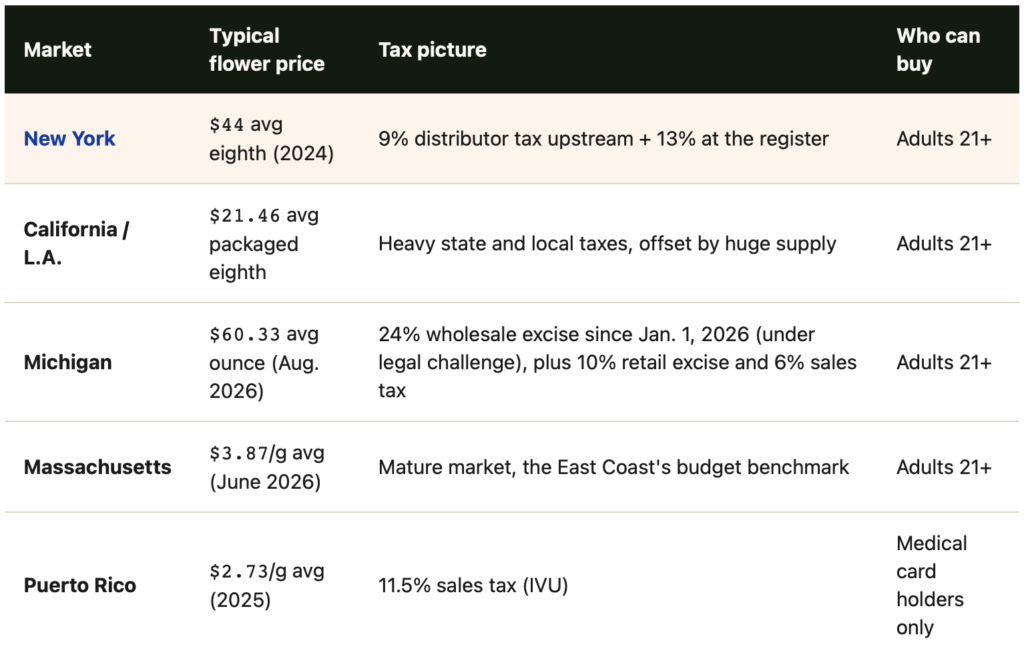
Figures come from state regulators (NY OCM, CA DCC, MI CRA, MA CCC) and the market study prepared for Puerto Rico’s regulator. Reporting periods differ. Your shop’s prices will vary.
Mostly because New York is early. Its own regulators studied older markets and found that retail prices eventually fell 60% to 76%, but it took time: 59 months in Massachusetts, 120 months in Colorado. Michigan’s ounce dropped 61% in 32 months, driven by wide-open licensing and a flood of supply. New York’s legal stores only started scaling in 2024, the indoor supply most shoppers want is still ramping up, wholesale prices are among the highest in the country, discount competition has been restricted, the federal tax penalty still applies to rec shops, and federal law bars importing cheaper product. Every one of those loosened years ago in the markets where weed is cheap now.
Slowly, yes. The state reports that average retail prices peaked near $39 per item in early 2024 and fell about 15%, to around $32, by late 2025. Headset’s data shows New York’s average item price at $29.05 in August 2026, down from $31.80 a year earlier. In Albany, the conversation has turned to reworking the cannabis tax structure, with the Assembly’s budget analysis, as reported by The Fresh Toast, projecting adult-use cannabis tax collections to grow from roughly $209 million this fiscal year to about $316 million next year. And if the DEA ends up moving all marijuana to Schedule III, New York’s rec shops would finally be in line for 280E relief, and some of those savings could reach the counter.
The cheaper stuff does exist if you look. On September 24, Housing Works’ Broadway menu had several eighths at $30 and half-ounces at $100, which works out to about $7 a gram. That’s not Michigan or San Juan money, but it’s a long way from a $60 jar.
Is it getting better here?et?
Buy bigger. The state’s own numbers show it: in 2024 the average eighth was $44 and the average ounce was $196. That’s about $12.57 a gram versus $7.
Compare value brands with the premium shelf. On the menus we checked, New York–grown value eighths testing well above 20% THC sold for $30, next to $50 jars.
Weigh the medical program carefully. Certified patients don’t pay the 13% adult-use retail tax. The program’s 3.15% tax is paid by the medical company and can’t be added to your receipt. But there are only about 31 medical dispensaries statewide, and patients have told the state medical products are too expensive, so compare prices before you pay for a certification.
Verify before you buy. Look for the state’s Dispensary Verification seal and license number, or check the OCM’s dispensary map. Licensed product is tested, tracked and recallable. An unlicensed shop’s product isn’t part of that system.
New York weed is expensive because every eighth carries two layers of state tax, comes out of a young supply chain with some of the highest wholesale prices in the country, can’t be replaced with cheaper out-of-state flower, gets sold out of relatively few stores paying New York rent, and still carries a federal tax penalty on the rec side. A high price at the counter doesn’t necessarily mean a high profit behind it, and the state’s own data shows many dispensaries are struggling even as a few big stores thrive.
Puerto Rico shows the other extreme: a medical market so oversupplied that flower now averages under $3 a gram and growers say they’re selling below cost. That’s great for patients’ wallets and rough on small businesses.
We support the legal market here at NYC Weed News. That means rooting for the licensed shops, and it also means holding Albany and Washington accountable for the costs they add. Prices are coming down. The question is whether they come down fast enough to beat the smoke shop on the corner.
Sources (all accessed September 24, 2026)
New York government
NYS Dept. of Taxation and Finance: Adult-use cannabis products tax, rates before June 1, 2024, and excise tax on medical cannabis
NYS Office of Cannabis Management: 2024 Market Report (June 2025), 2025 Annual Report (Dec. 2025), and Aug. 6, 2026 Cannabis Control Board release
Puerto Rico government
V2A Consulting, market study prepared for the Junta Reglamentadora de Cannabis Medicinal, Actualización del estudio de mercado de la industria del cannabis medicinal (Departamento de Salud, Feb. 26, 2026)
Departamento de Hacienda, Determinación Administrativa Núm. 17-06 (IVU on medical cannabis)
Patient and dispensary counts from the Health Department and JRCM, as reported by Medicina y Salud Pública (April 2026) and Revista Crónicas (Health Dept. data to the Senate, June 2026)
Federal
Congressional Research Service, Department of Justice Eases Control of Medical Marijuana (April 2026); Federal Register DEA hearing notice; Foley Hoag analysis; Cannabis Business Times on rescheduling status (Sept. 11, 2026)
Other states and market data
California Department of Cannabis Control data dashboards (price per unit; the $21.46 eighth figure is from DCC data as published in September 2026) and DCC production data via the California Senate
Michigan: Cannabis Regulatory Agency monthly reports (August 2026 average adult-use ounce); Department of Treasury, Wholesale Marijuana Tax and Revenue Administrative Bulletin 2026-3; mlive via CPA Practice Advisor on the court challenge (April 2026); Cannabis Business Times on Michigan inventory
Massachusetts: Cannabis Control Commission Open Data Platform (June 2026 adult-use average price per gram)
LeafLink 2026 Wholesale Cannabis Pricing Guide; Cannabis Benchmarks U.S. Spot Index; Headset New York; Lit Alerts East Coast Eighth Index; Ganja.com Los Angeles prices
The Fresh Toast on New York tax collections; CBS News on the unlicensed-product study; MJBizDaily on the 2026 lab recall; Northstar Financial margin benchmarks
NYC Weed News menu check
Housing Works Cannabis Co., Broadway (checked Sept. 24, 2026); Cannadreams (store’s live-menu summary dated Sept. 13, 2026); Flora, San Juan (checked Sept. 24, 2026). New York potential-customer estimate: OCM population figures (19.6 million), an adult share of about 78%, and the state’s 14.7% past-month adult use rate (BRFSS 2023, via the OCM 2025 Annual Report).
© 2026 NYC Weed News. All rights reserved. Original photography and editorial content may not be reproduced, republished, distributed, or used commercially without written permission.
Editorial Disclosure: This article is independent reporting and was not sponsored, reviewed, or approved by a cannabis licensee. NYC Weed News does not sell cannabis and does not receive a commission from cannabis purchases. References to specific businesses are included for news and identification purposes and do not constitute an endorsement. Cannabis is legal in New York only for adults aged 21 and older. Do not drive while impaired.
Image Credits: All images used in this article are licensed through Adobe Stock for editorial use. Images are the property of their respective photographers and are used in accordance with Adobe Stock’s editorial licensing agreement.
© 2026 NYC Weed News. All Rights Reserved. Independent media covering New York cannabis culture, news, and street life.
NYC Weed News is a creative-first independent media group. Our visual content is produced using a range of AI image generation models including MidJourney, Adobe Firefly, DALL·E, and others. We embrace AI as a core part of our creative identity — and we make no apologies for it.
NYC Weed News is an independent media and informational platform focused on cannabis news, culture, mapping, events, and licensed industry resources. We do not sell cannabis products.
All content is intended for adults aged 21+ and is for informational and educational purposes only. No content on this website should be interpreted as medical or legal advice. Always comply with local laws and consult a licensed professional where required.