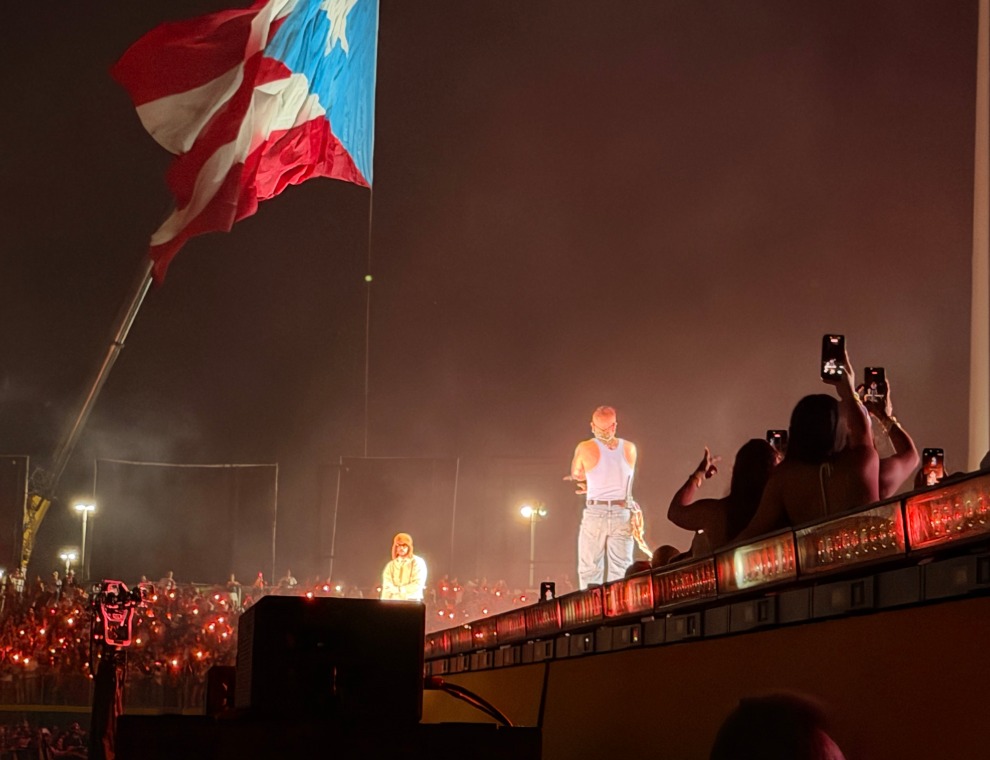
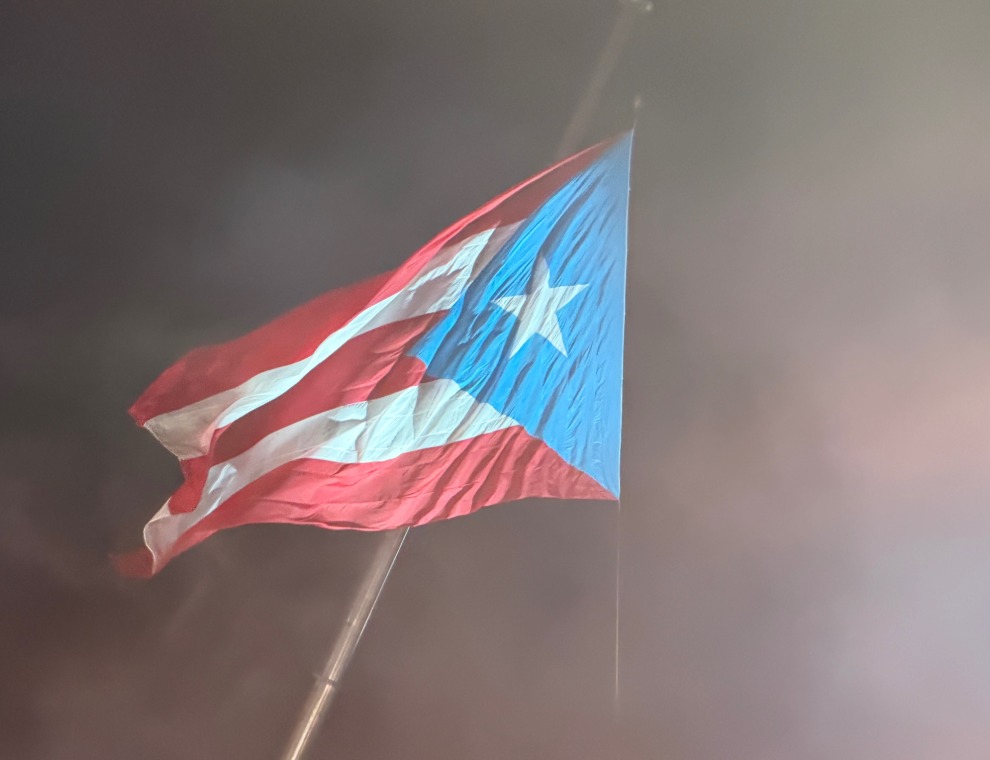
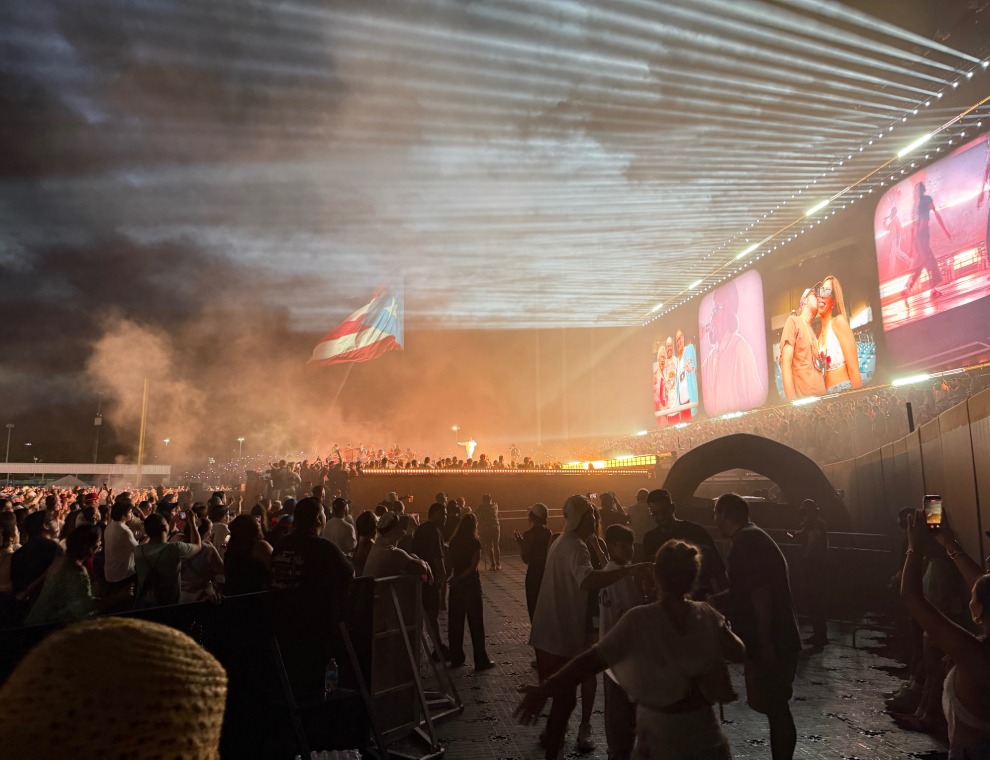
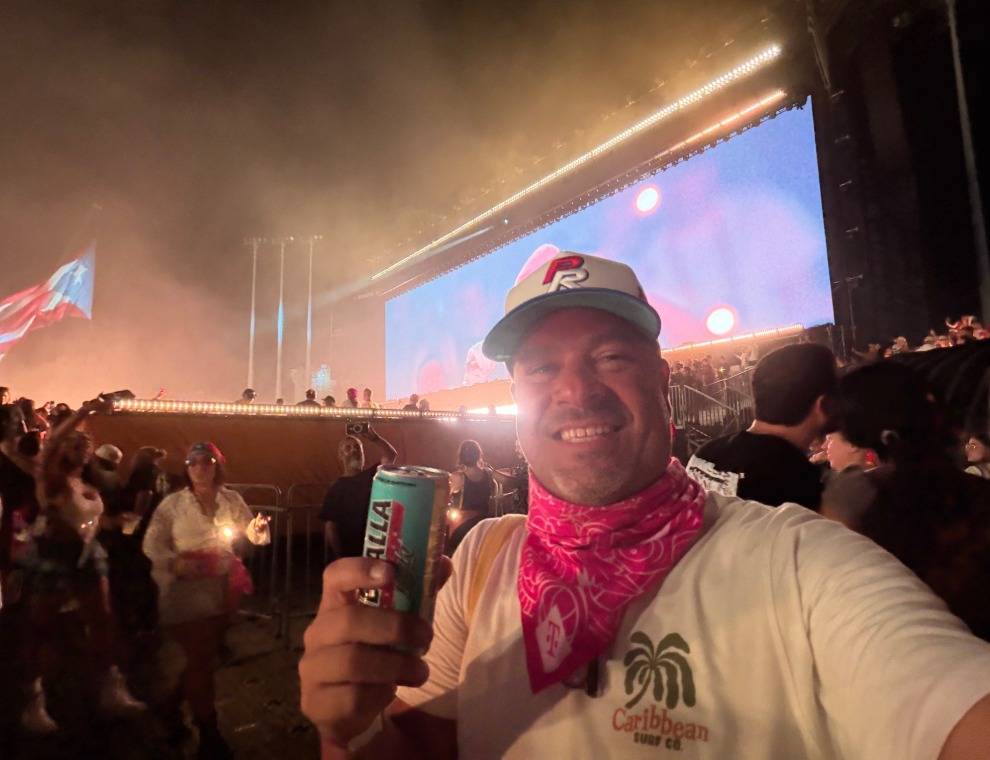
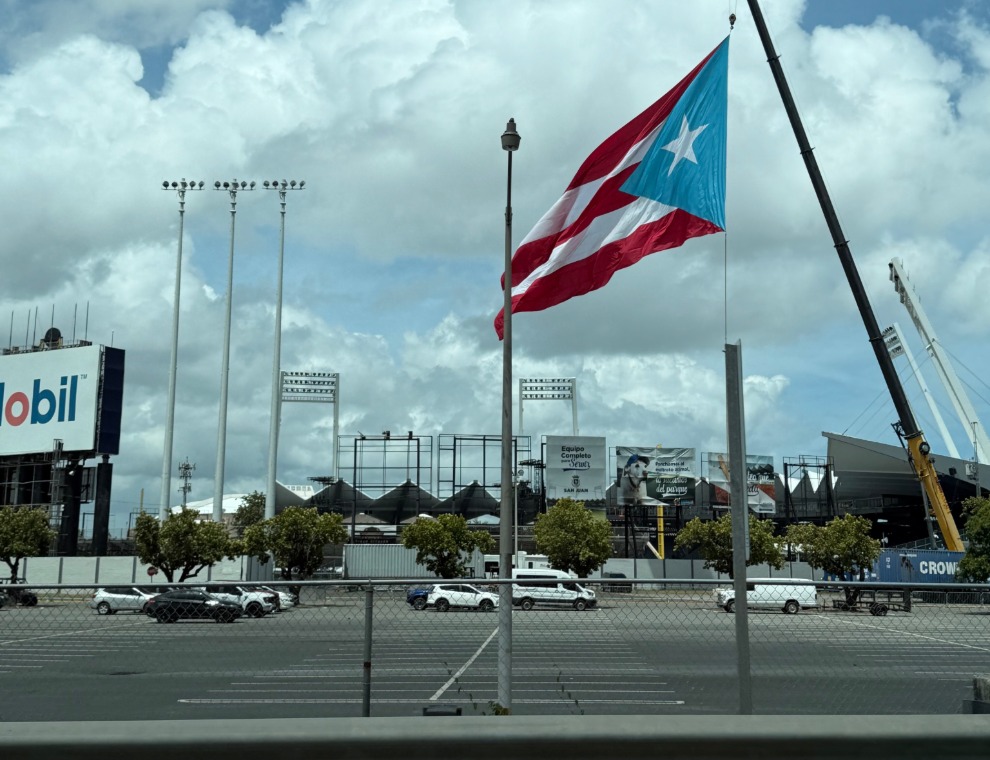
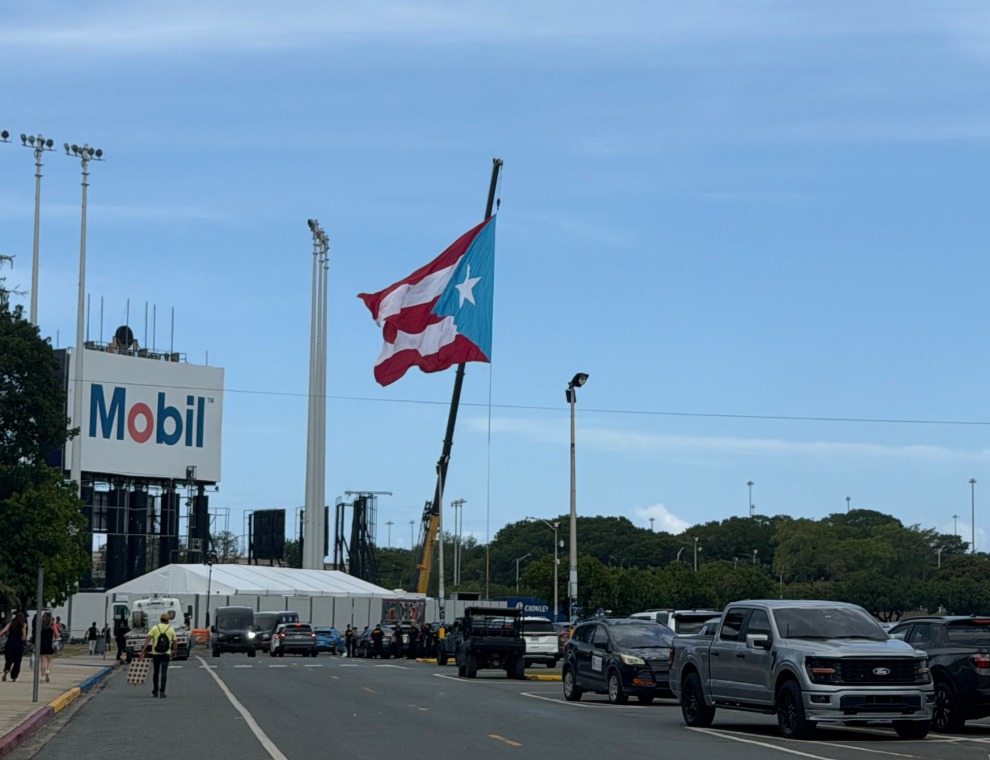
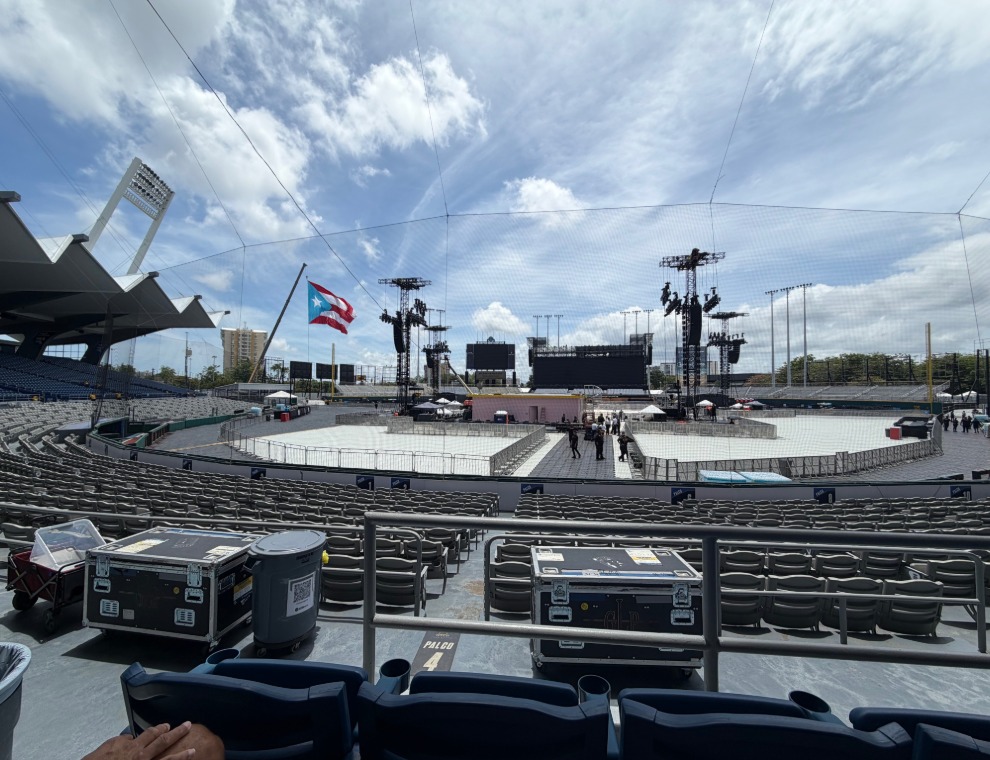
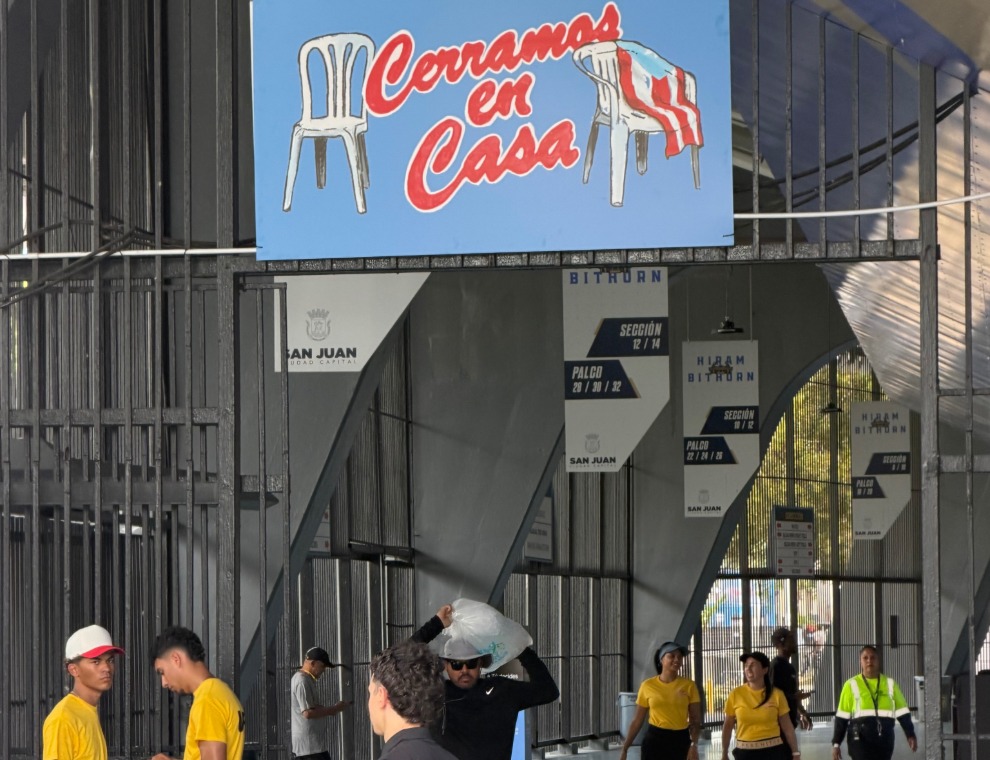
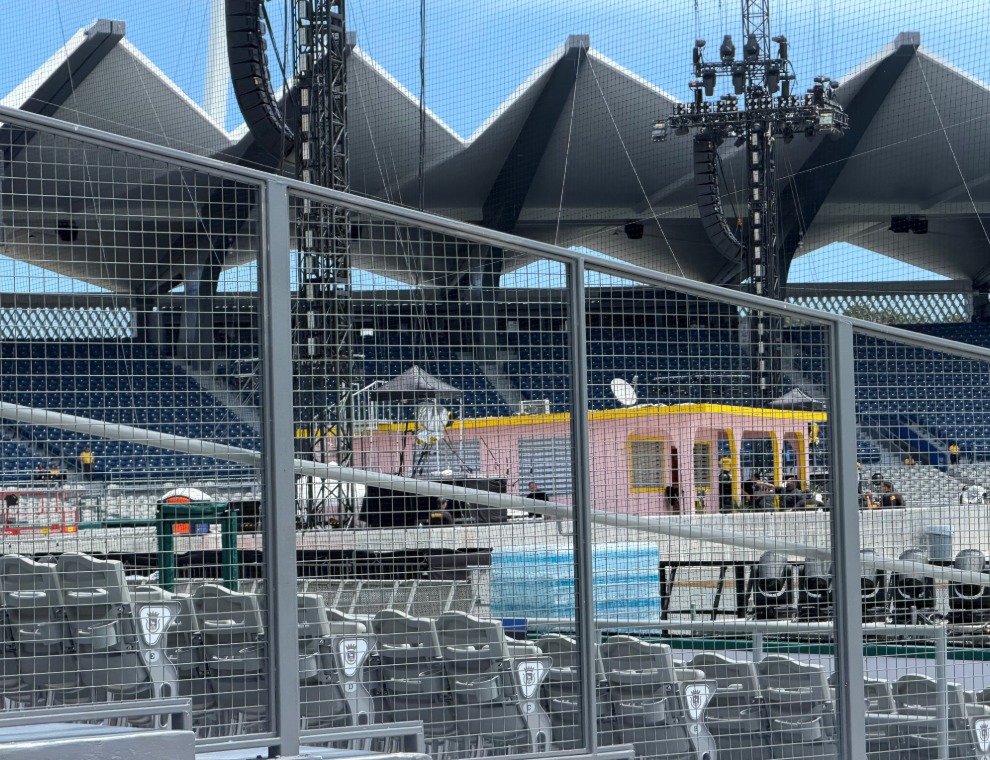
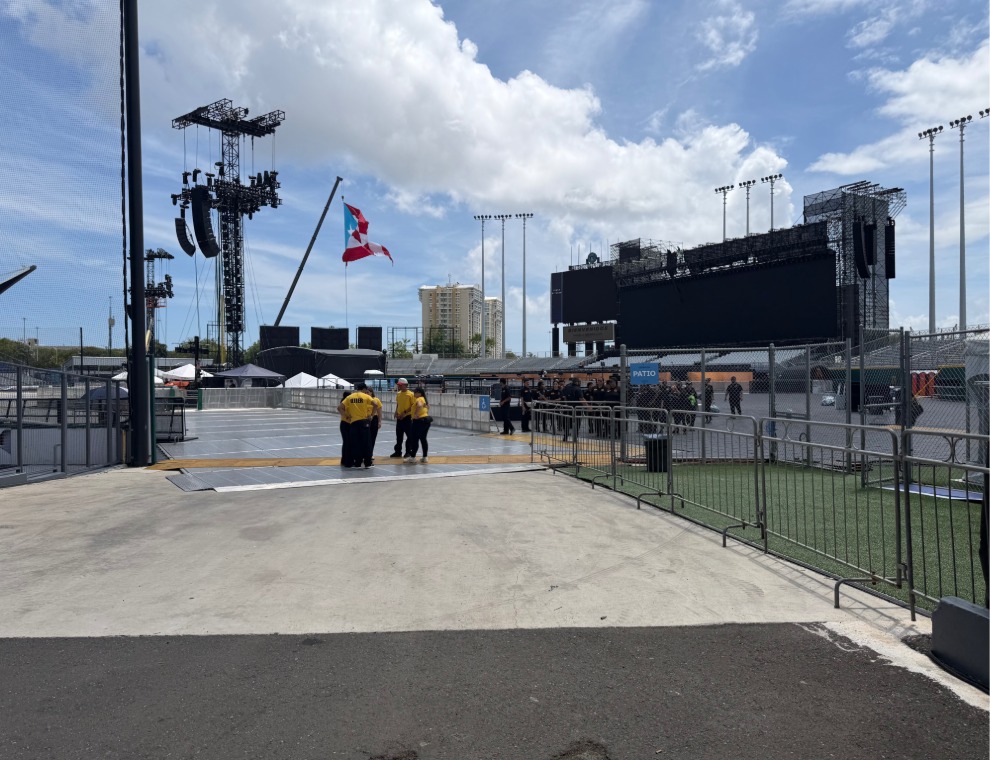
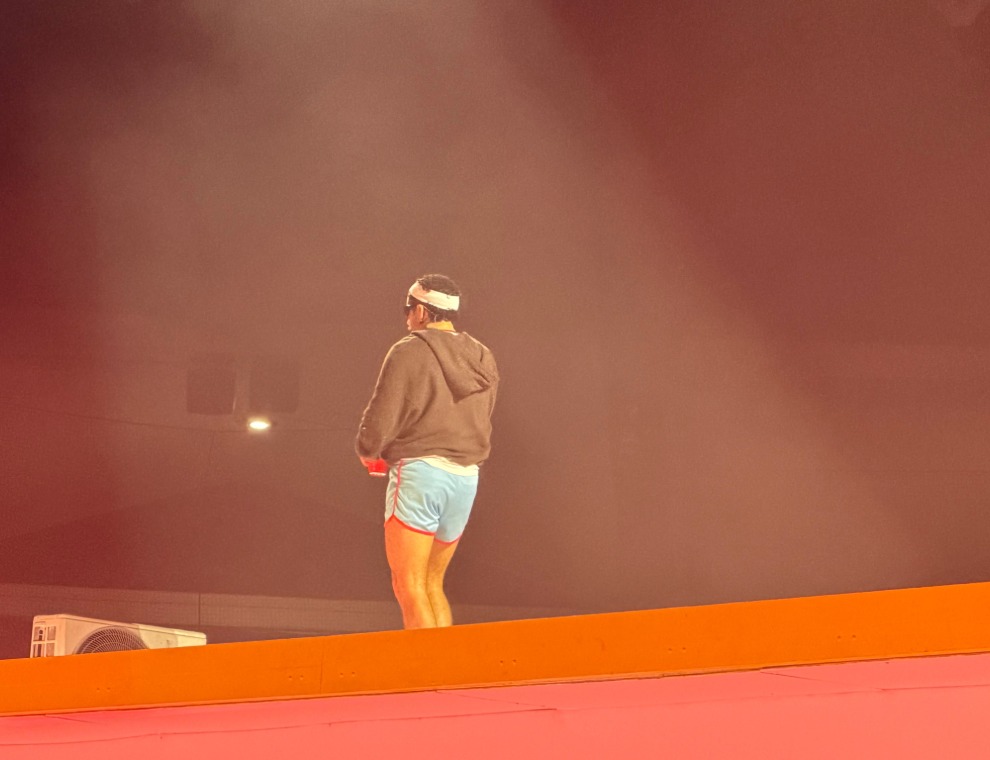
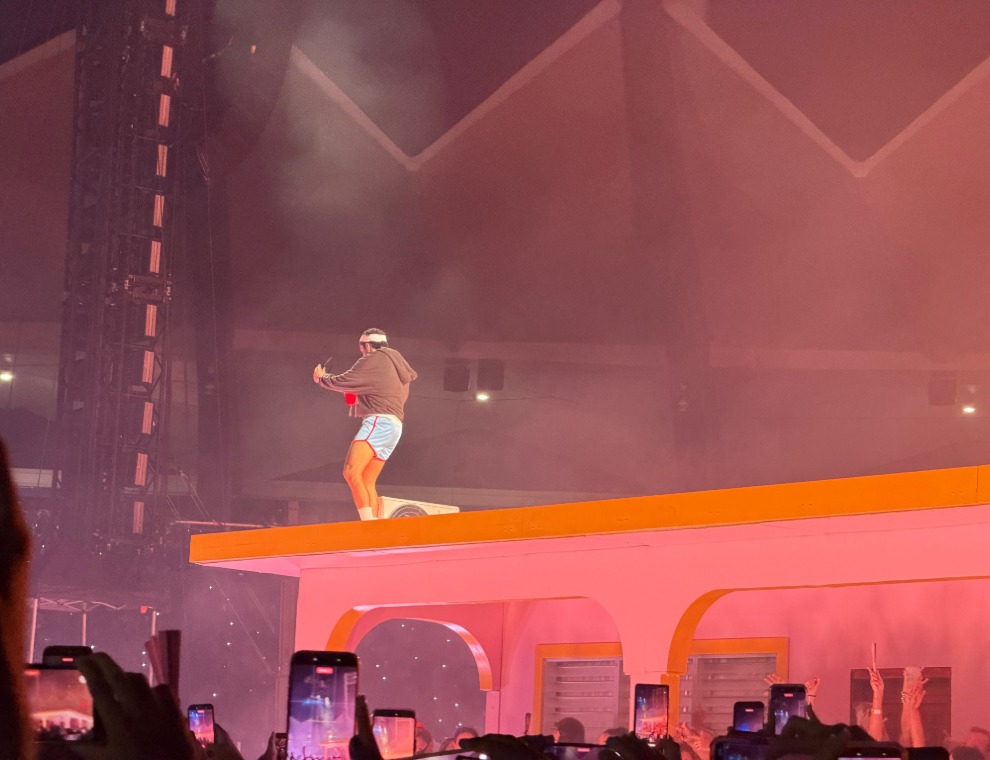
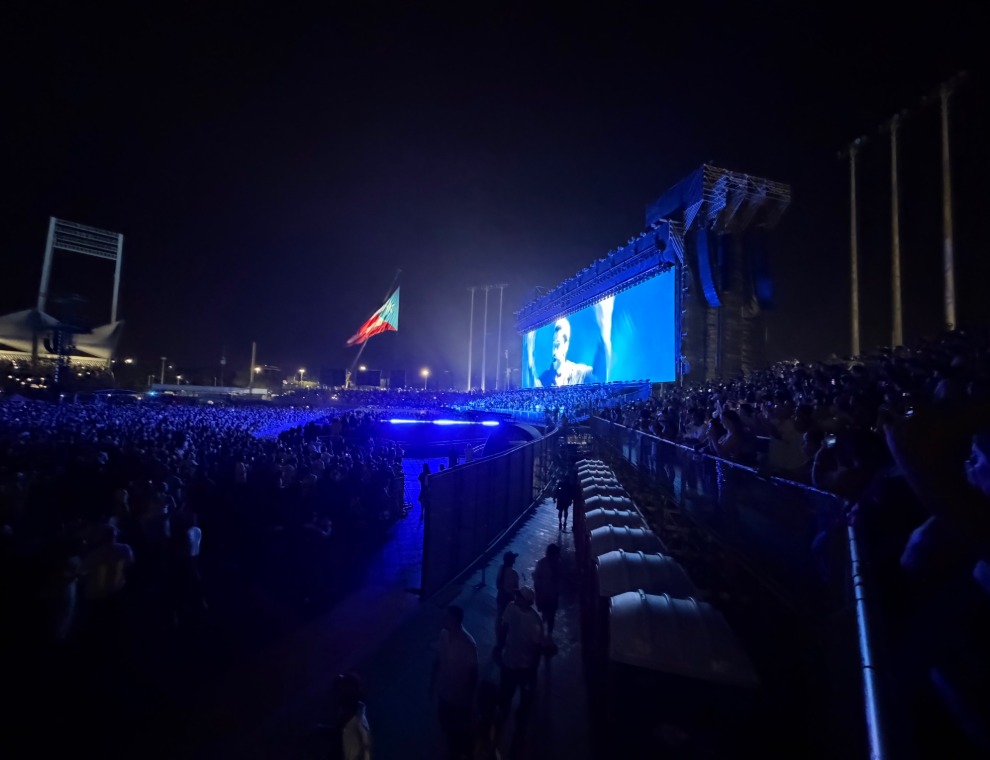
From where I was working, the flag was bigger than the stage. It hung from a crane above the upper deck, catching the wash of the concert lights and the haze settled over the field, and for a moment it made the crowd underneath look small. I had a job to do inside that stadium that weekend. But before I found it, I found myself staring up at the flag.
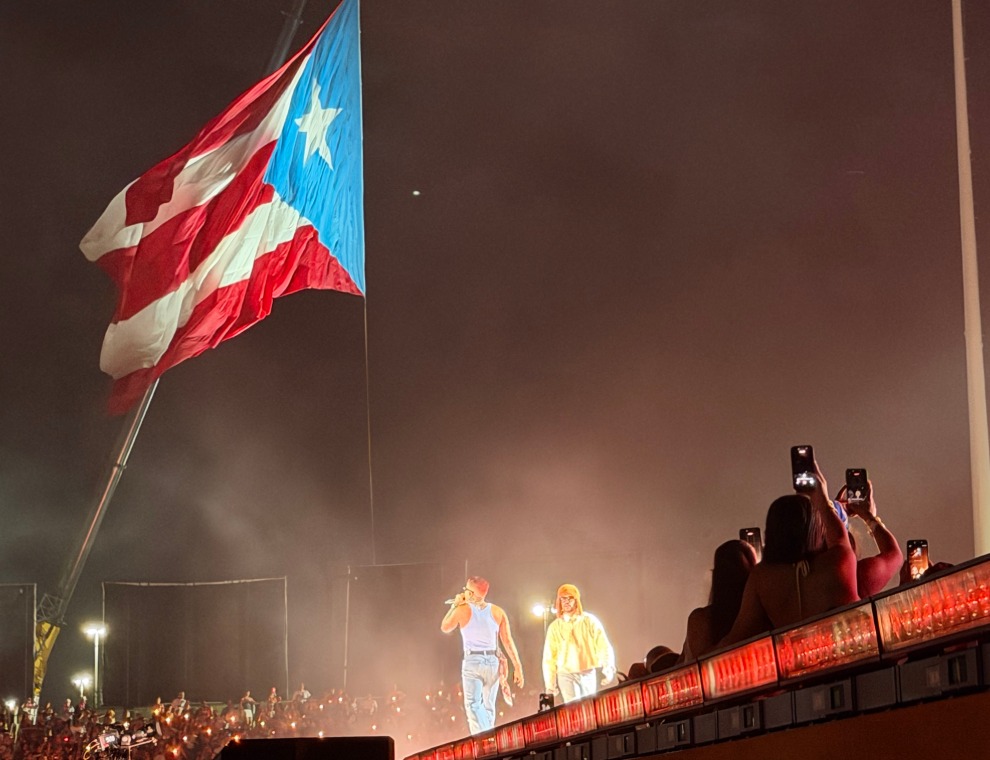
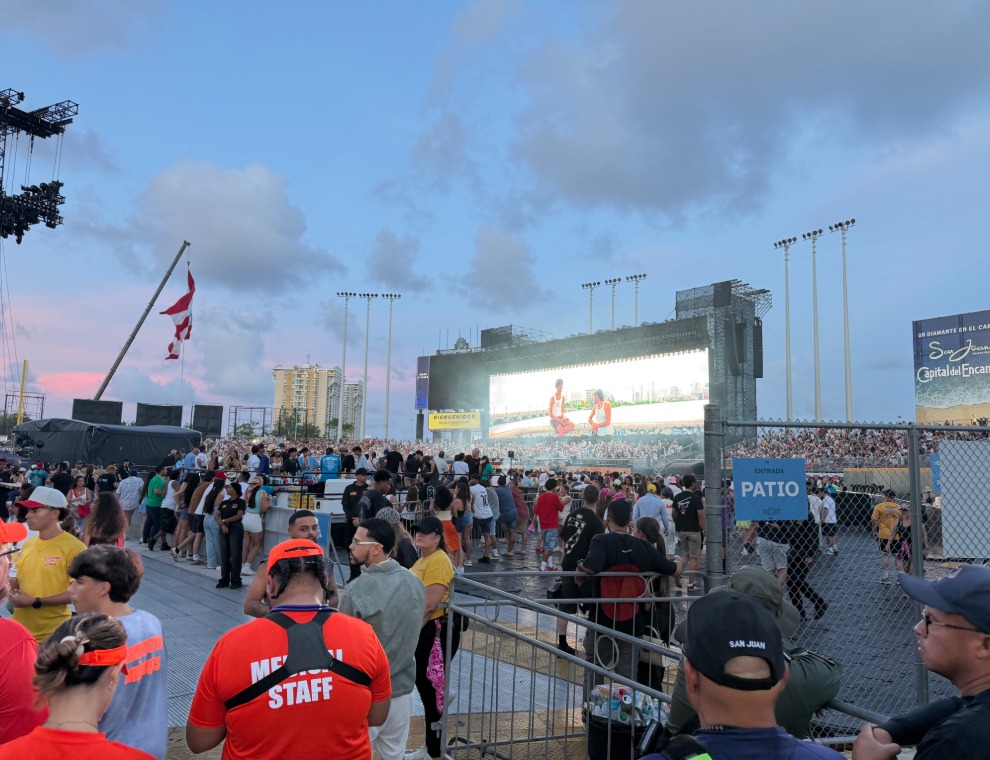
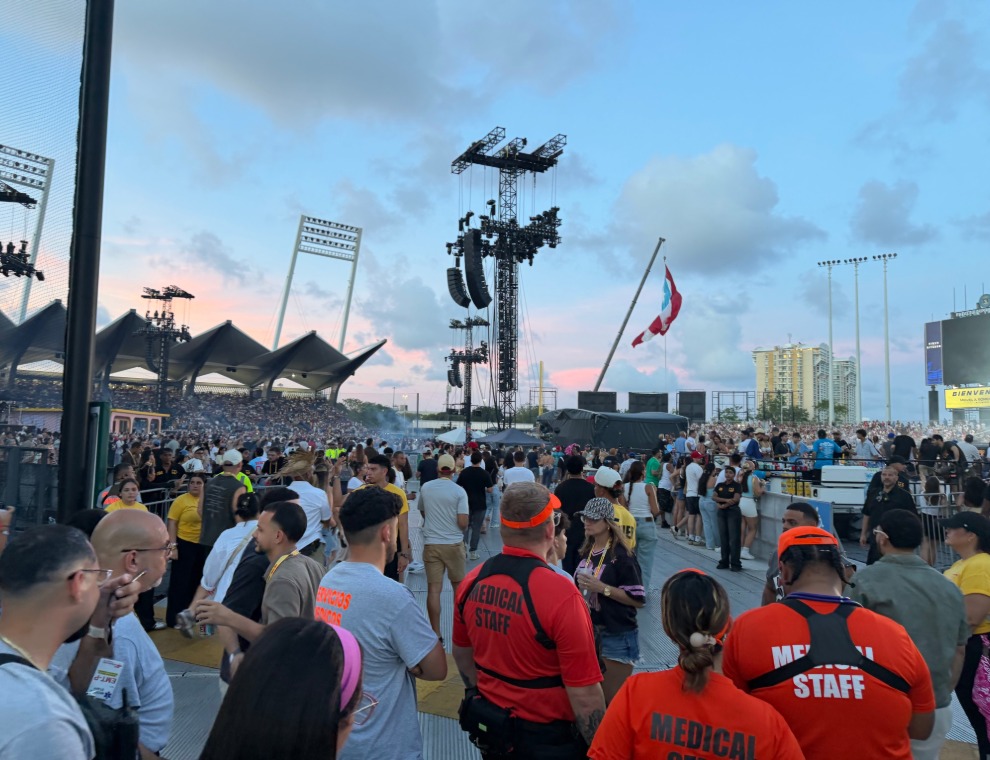
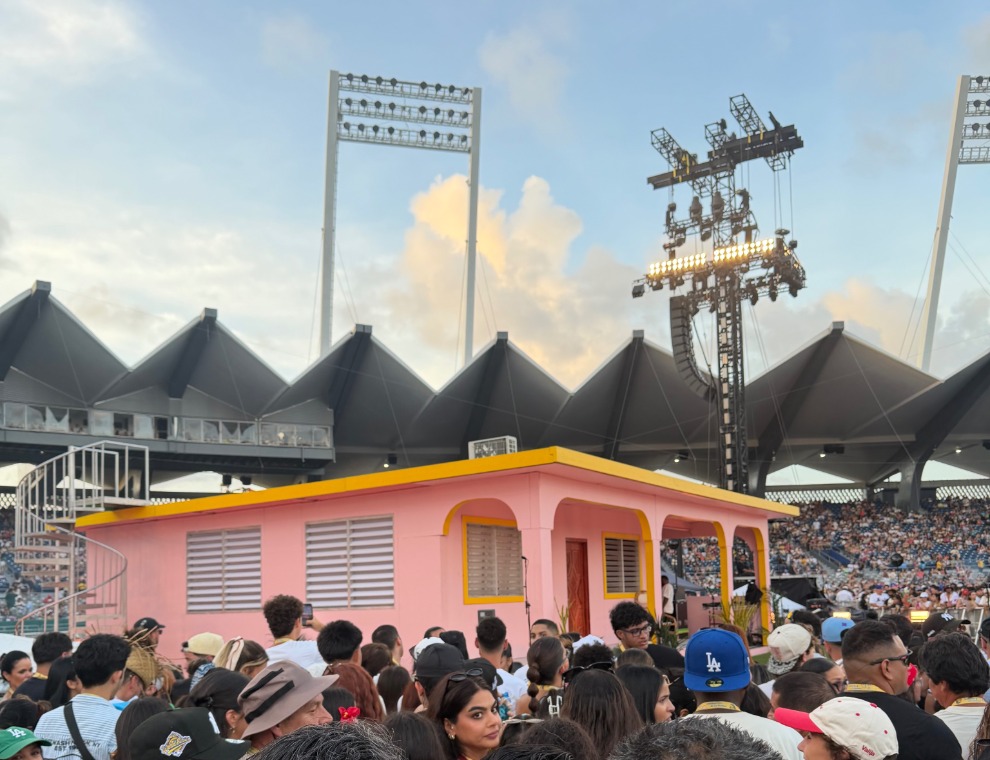
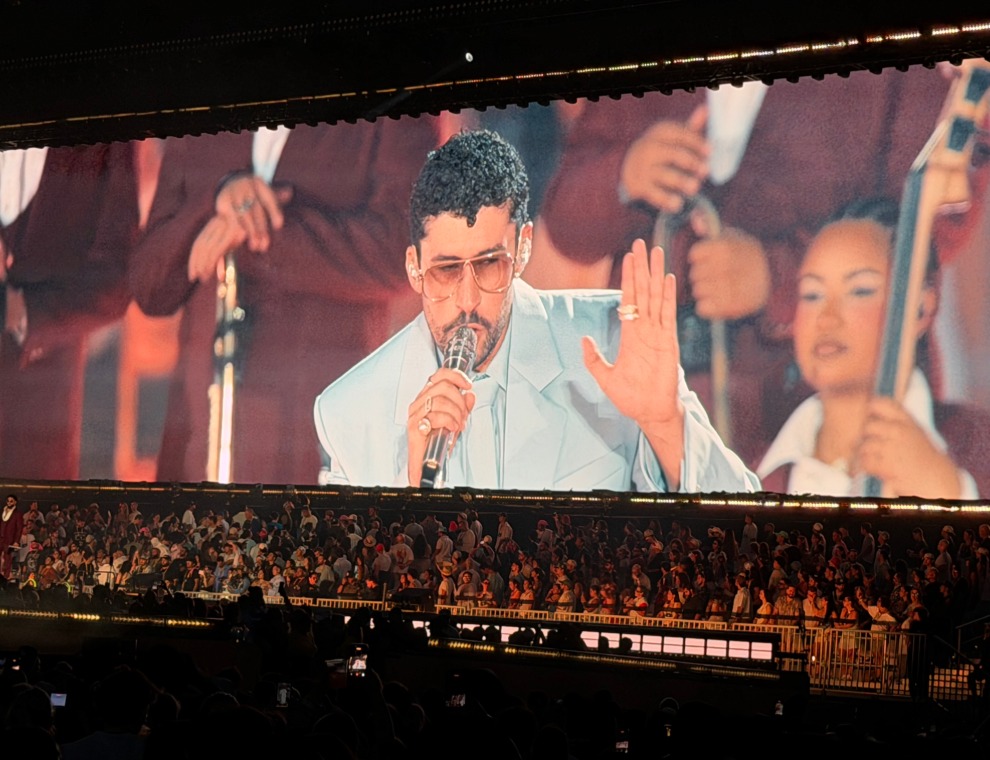
A massive Puerto Rican flag rises above the crowd at Hiram Bithorn Stadium during Bad Bunny’s closing “Cerramos en Casa” concerts in San Juan, suspended from a crane over a stadium filled with light, haze, and thousands of people. The flag’s noticeably lighter blue added another layer of symbolism to a show deeply rooted in Puerto Rican identity. Photo: NYC Weed News / Damián Antommarchi.
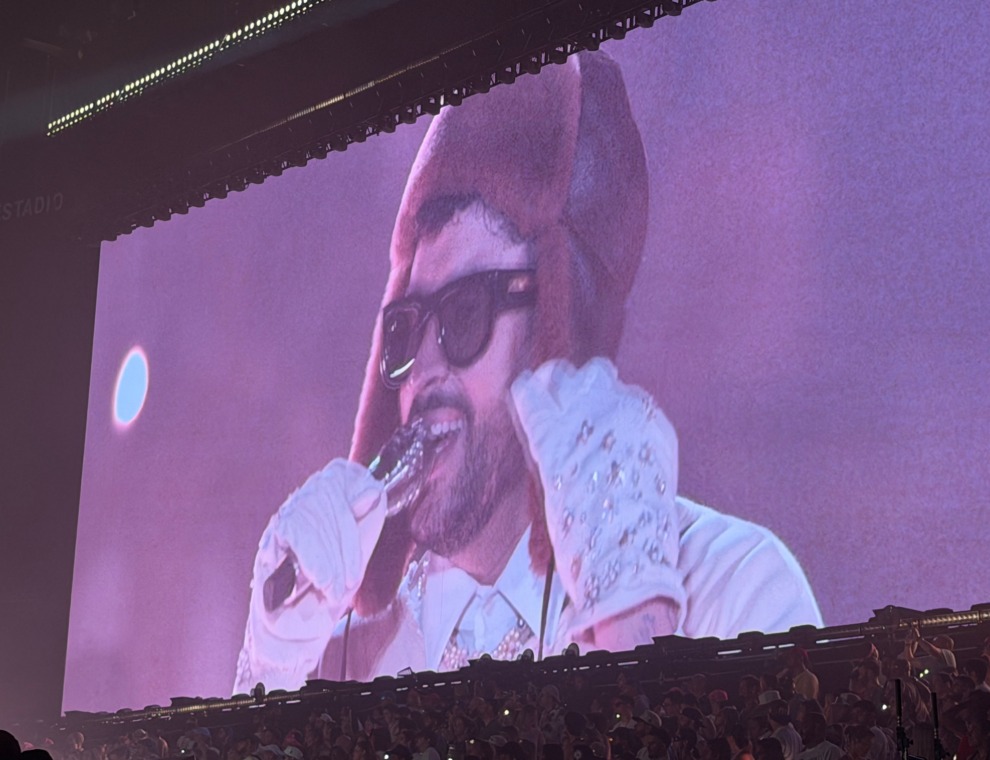
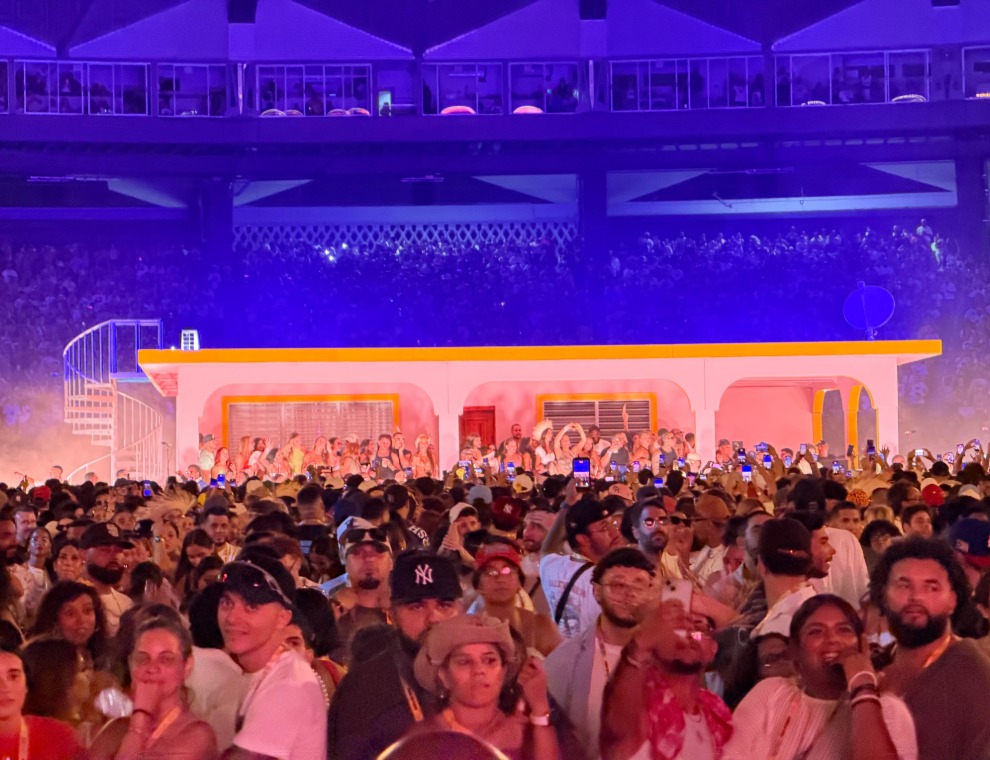
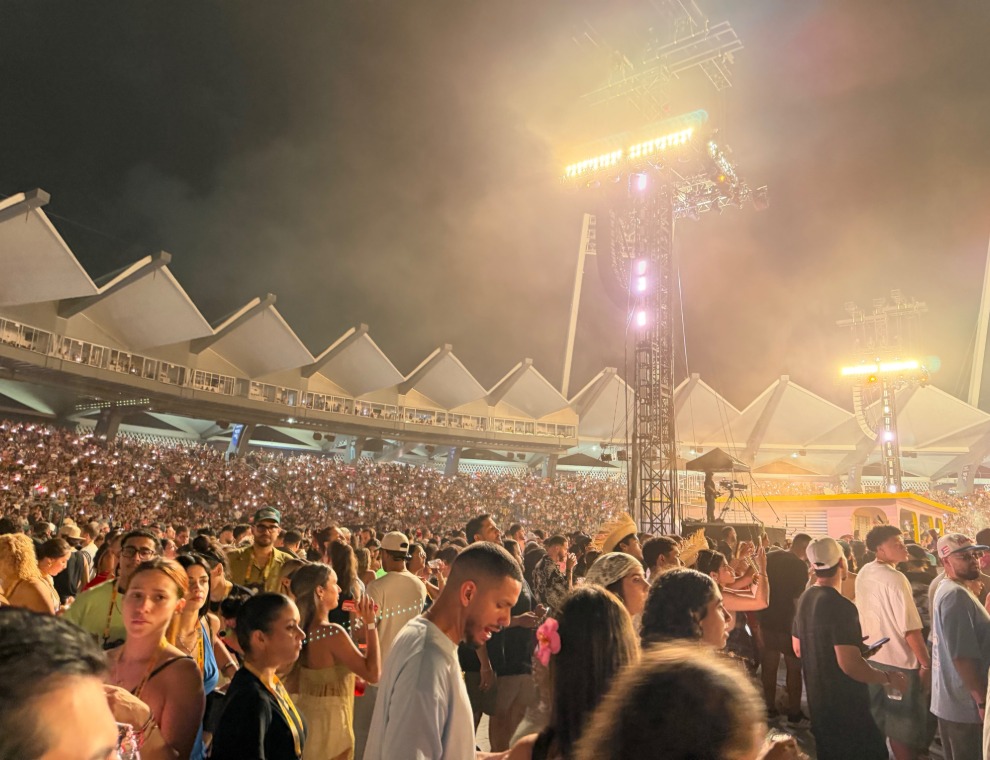
You could feel it before the show started — moving with the wind off the field, lit from below, smoke and haze drifting around it. Hiram Bithorn was already full, a bowl of noise and phone lights and heat, and the flag hung over all of it: enormous, deliberate, impossible to ignore. I wasn’t the only one who noticed. Local outlets covering the shows described the same thing — a giant Puerto Rican flag fluttering at one end of the stadium while thousands chanted Bad Bunny’s name before he ever appeared.
What struck me wasn’t just the size. It was the color.
The blue in the triangle wasn’t the darker navy most Puerto Ricans grew up seeing on flags at government buildings and baseball games. It was lighter — closer to a sky blue, almost turquoise under the stage lights. That distinction matters more in Puerto Rico than it might look from the outside. The island’s flag traces back to 1895, designed by Puerto Rican Revolutionaries and Nationalists living in Puerto Rico and New York. No single, universally agreed-upon shade of that original blue survives in the historical record. But over generations, lighter interpretations of the blue have come to carry their own meaning here — tied less to the modern Commonwealth flag and more to an older, more defiant reading of what the flag stands for: independence, sovereignty, resistance, a Puerto Rico that answers to itself.
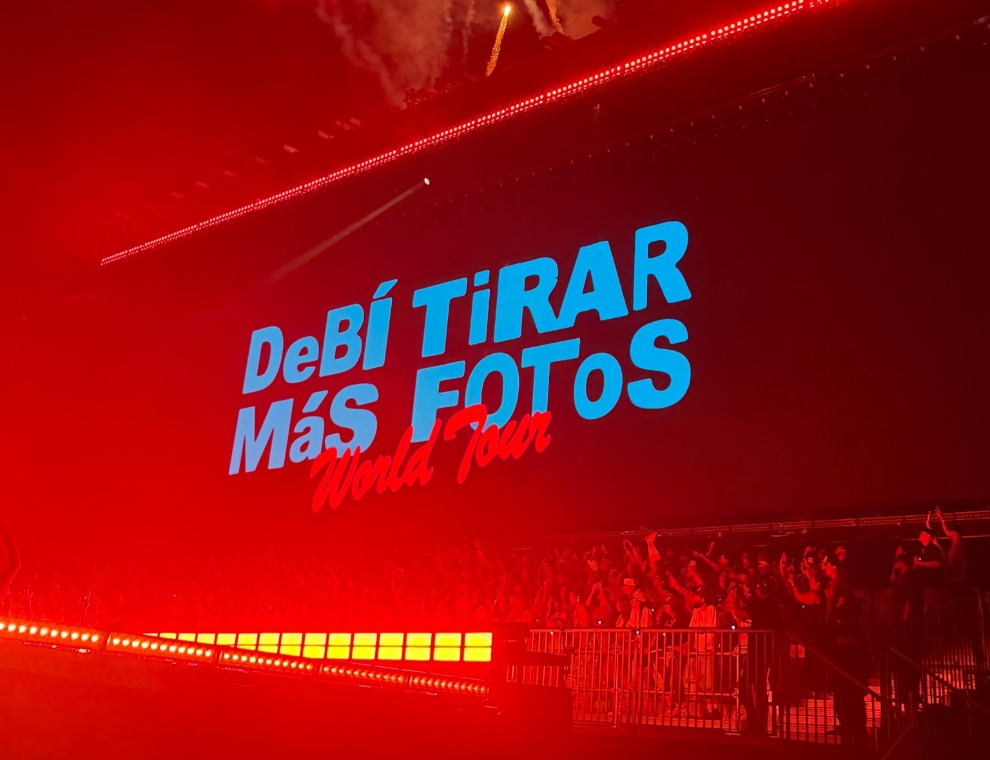
Whether that was the intention behind this particular flag, I can’t say with certainty. But at a show built this heavily around Puerto Rican identity and memory — a tour that closed, fittingly, with the words “cerramos en casa” — the choice didn’t read as accidental.
It was identity at stadium scale.
Before Bad Bunny took the stage, Puerto Rico’s flag had already taken it.
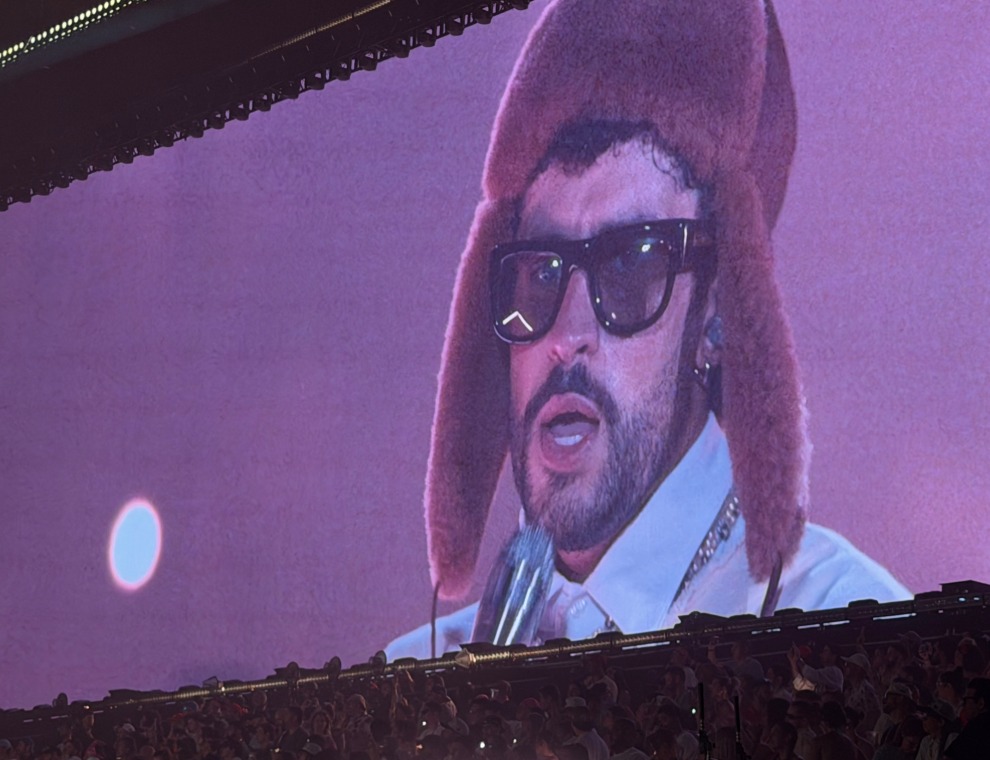
The Bithorn Was Built for Baseball, Not This
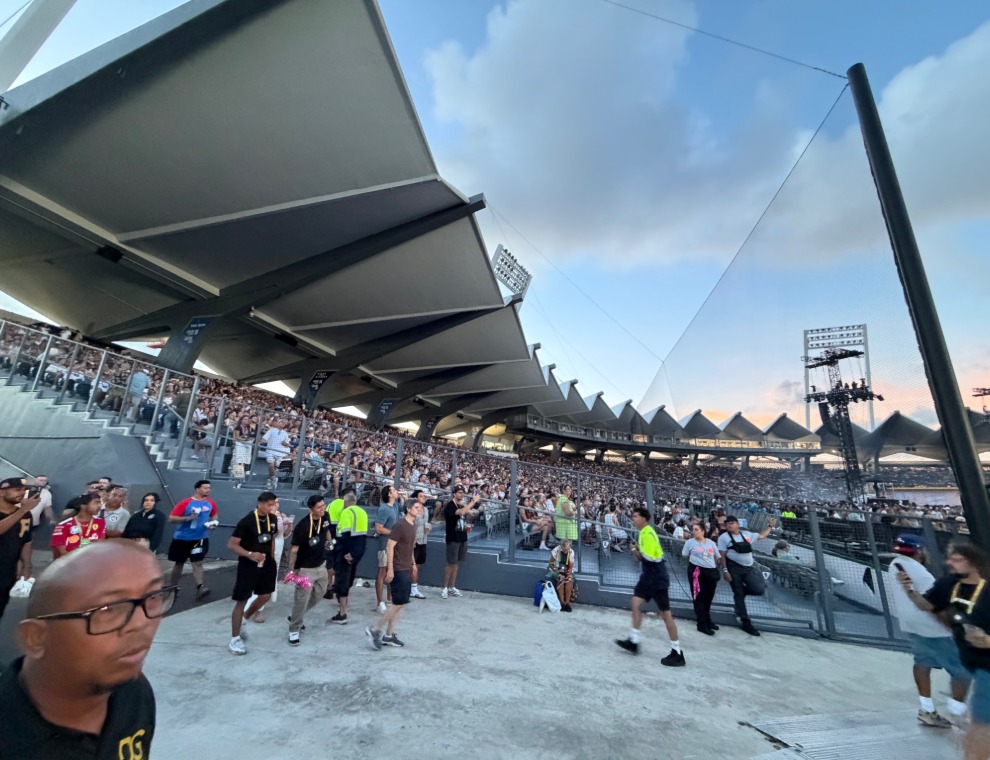
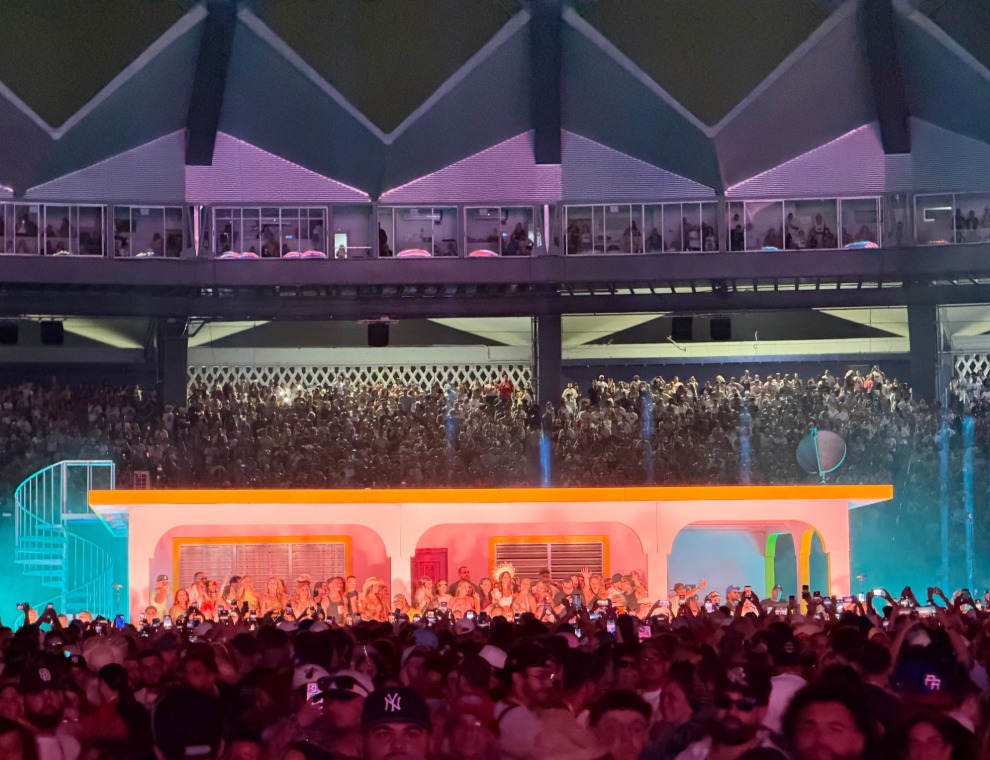
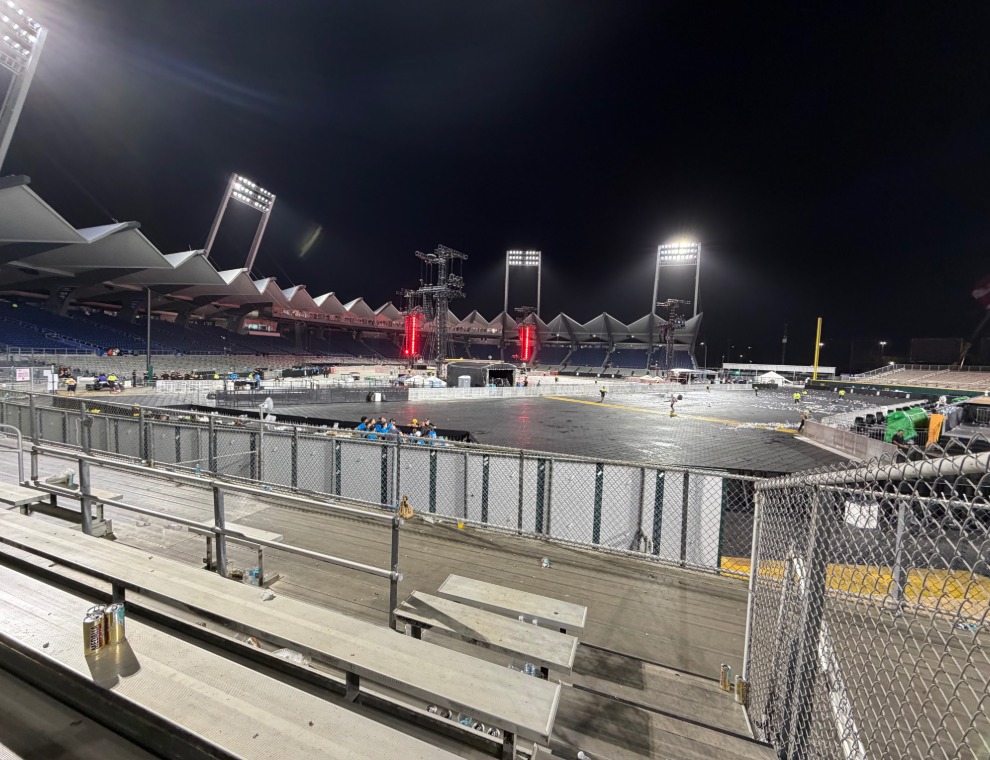
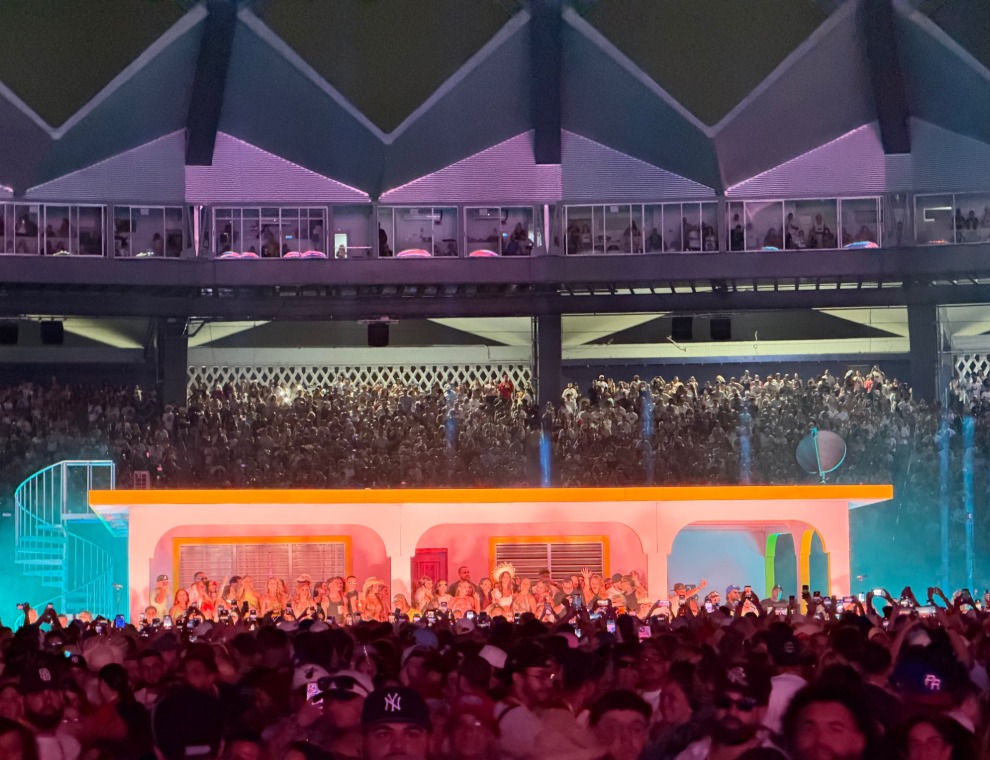
Hiram Bithorn Stadium wasn’t designed for any of this. It opened in 1962 as a baseball stadium — infield dirt and outfield grass, not rigging trusses and a suspended flag the size of a small building. It’s hosted generations of Puerto Rican baseball, international tournaments, and one strange chapter of MLB history: in 2003 and 2004, the Montreal Expos played part of their home schedule there. It’s hosted concerts too, by Whitney Houston, Shakira, and Rihanna, long before this Bad Bunny weekend.
But the stadium I worked in wasn’t the one that hosted those earlier shows. The Municipality of San Juan had just poured roughly $40 million into renovating the Bithorn ahead of the 2026 World Baseball Classic — new playing surface, new seating, structural reinforcement. That’s the cost of the renovation itself, not the concerts; I have no verified number for what these shows cost to produce.
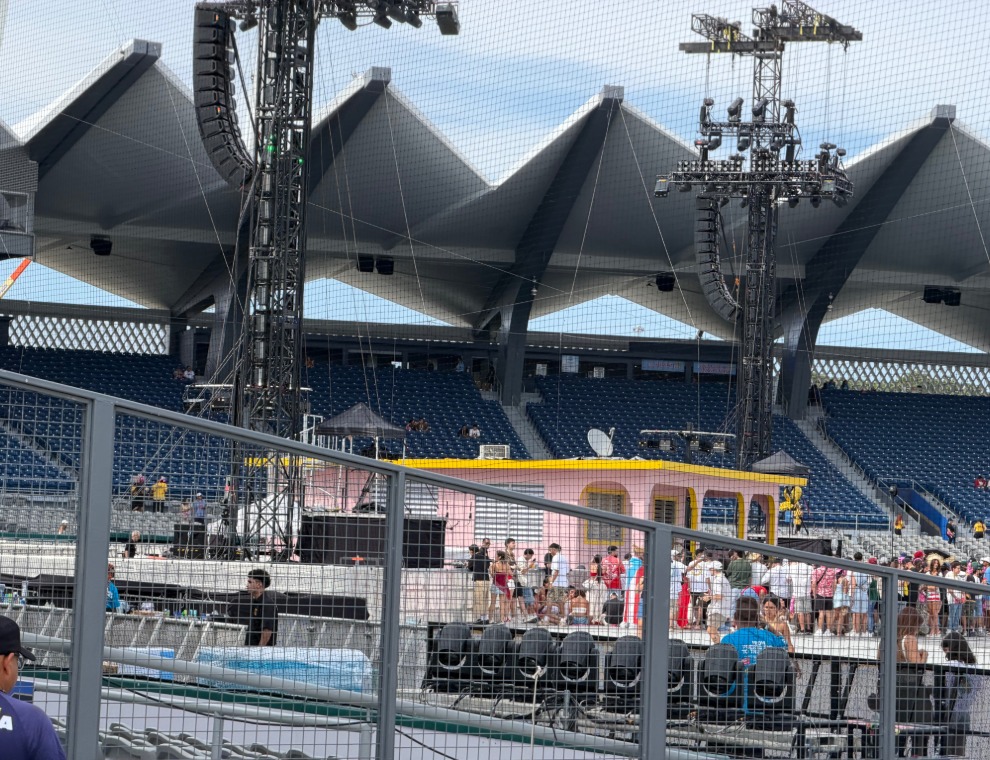
According to El Nuevo Día, a special protective floor owned by the municipality was installed over the playing surface, and the pitcher’s mound was flattened to accommodate it. The production reportedly carried a $5 million insurance policy covering possible facility damage — not a production budget, just protection for the field underneath it. City crews were reportedly back on the mound almost before the last song ended, aiming to have it tournament-ready within two weeks.
Layer by layer, temporary flooring, barricades, cables, and rigging turned a freshly renovated baseball stadium into a concert venue — and then, just as fast, had to turn it back.
Minutes before the gates opened, I watched what appeared to be supervisory fire personnel walking the facility. I don’t know exactly what they were checking — I wasn’t part of that conversation. What I can say is what I saw: a small group moving through the building with the unhurried focus of people whose job is to notice things the rest of us wouldn’t.
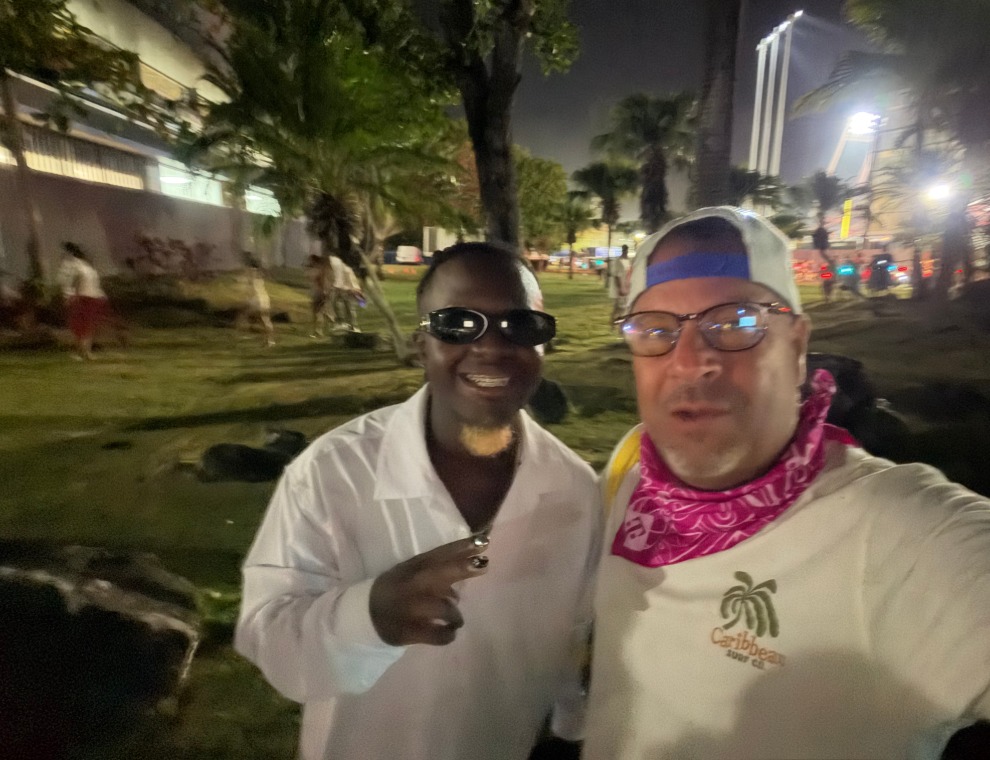
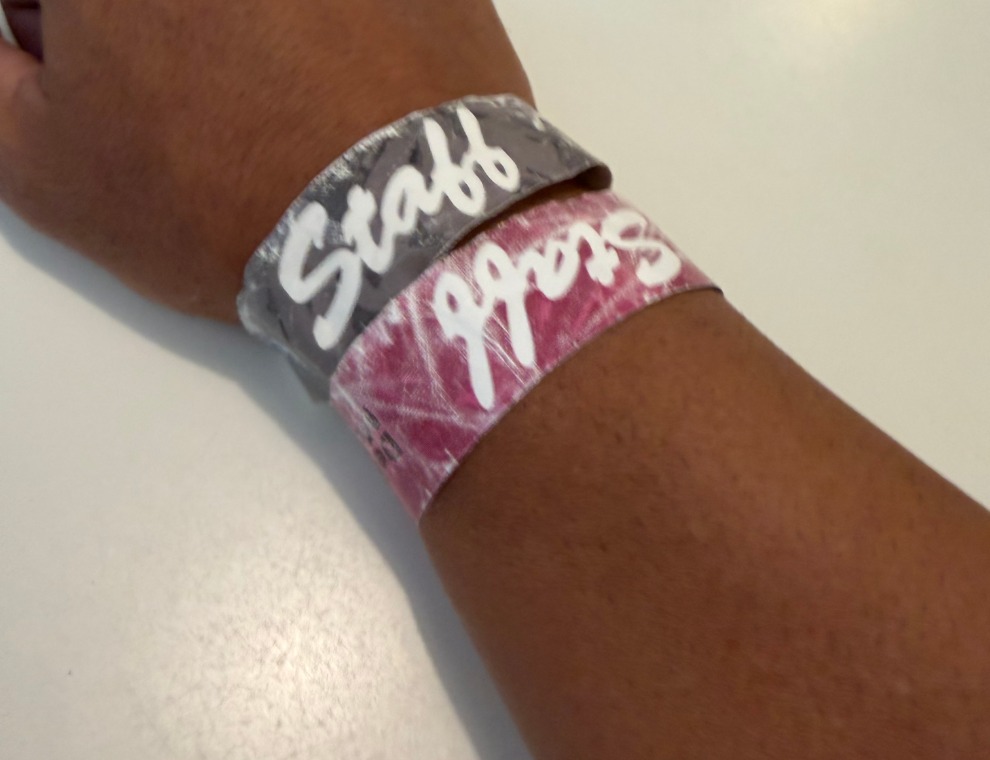
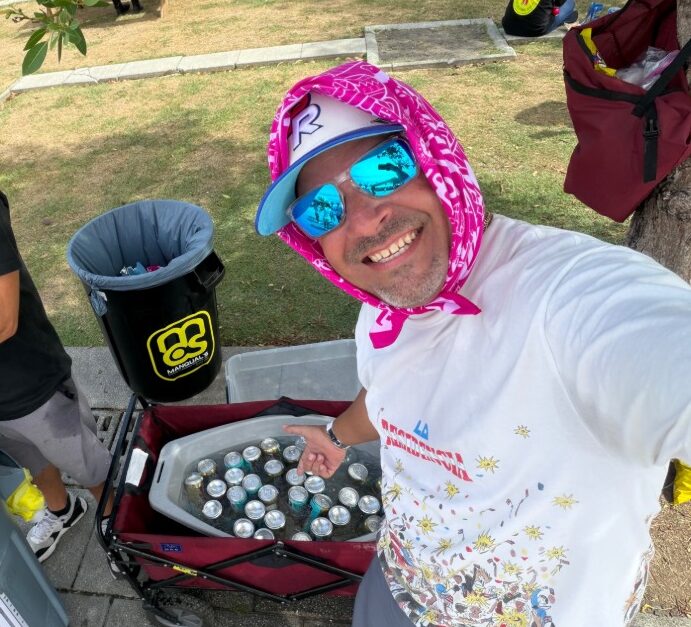
My way into that weekend was as a hawker — the term the operation used for the vendors who move through the stands selling beer and concessions. I worked both nights. There was a check-in table outside Hiram Bithorn for hawkers, where workers signed in before heading inside. Day one, I made it in time. No story there.
Day two, I was late — and that’s on me.
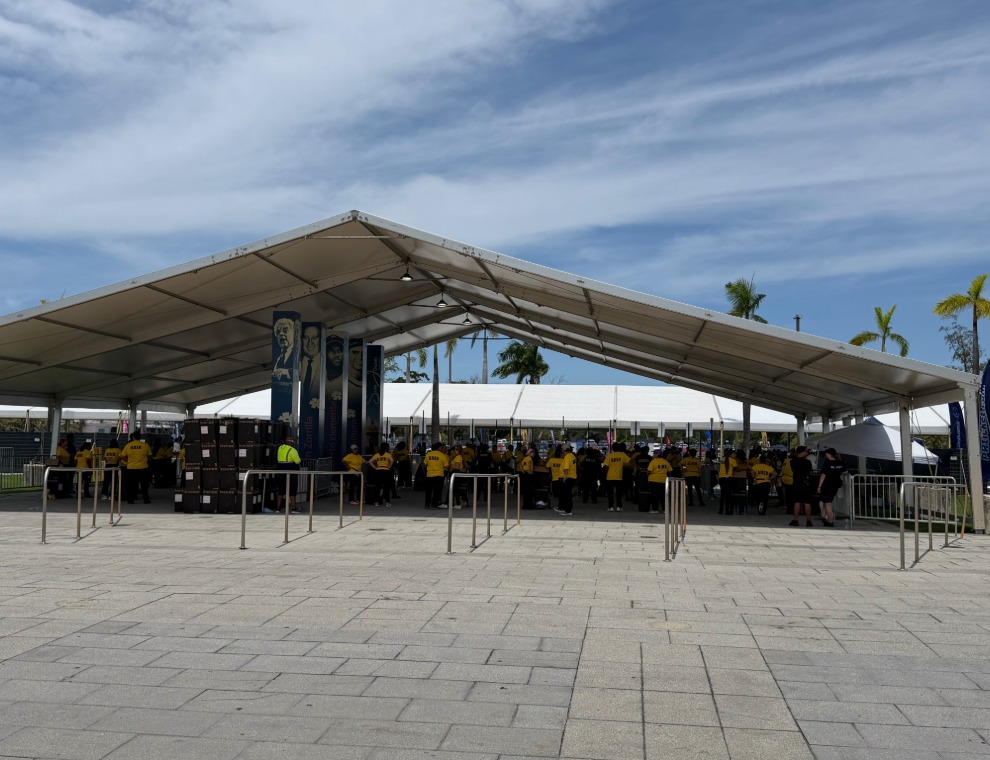
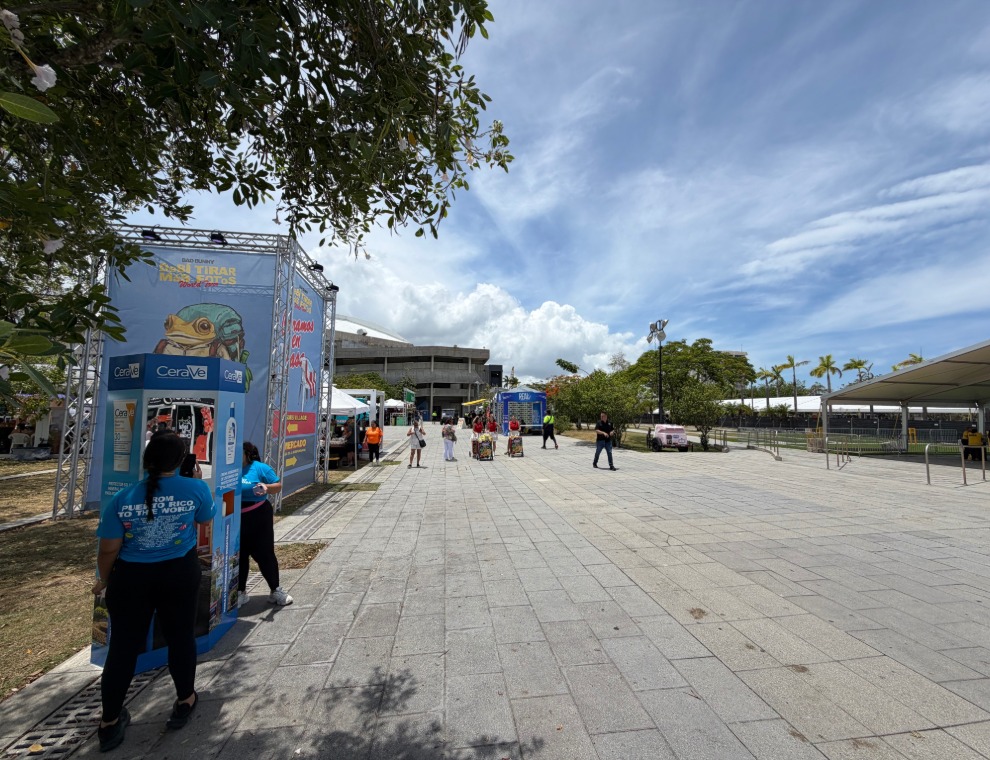
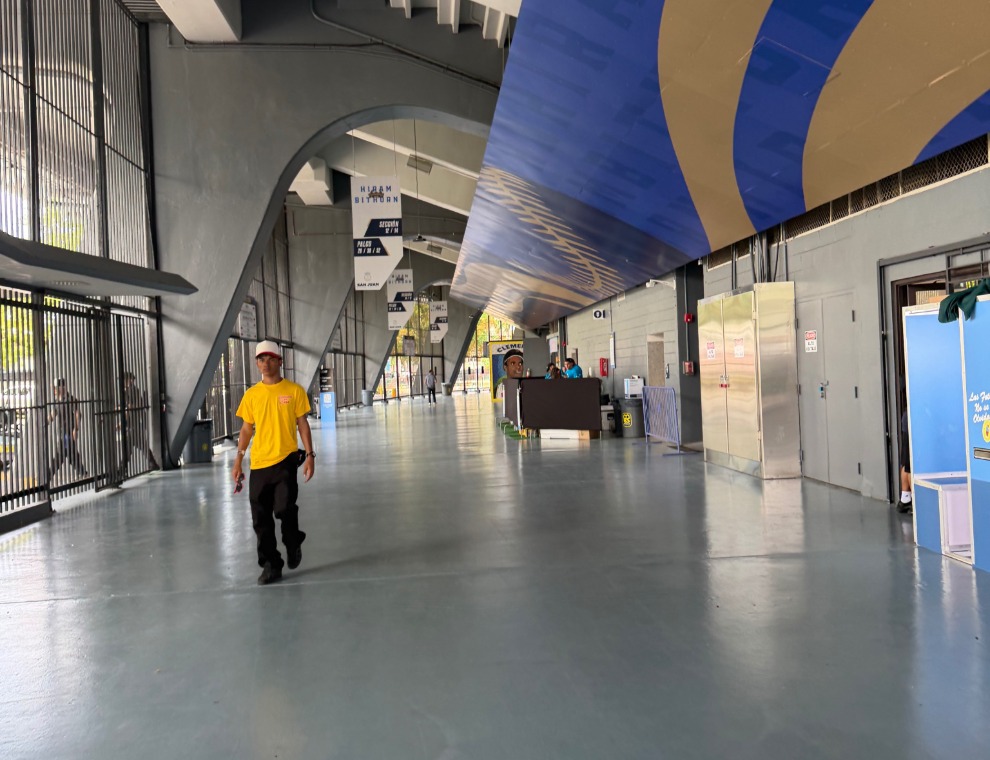
By the time I got there, the outside table had already closed. The roster had been transferred inside, to a location the operation called Hawker Base. Not a folding table on the sidewalk anymore — a base, somewhere in the building, I now had to find on my own.
Finding it took longer than it should have. Hiram Bithorn on a show day doesn’t explain itself — concourses that all look the same, staff pointing different directions, a stadium mid-transformation from empty structure into full production. I asked around. I doubled back. At some point it stopped feeling like I was looking for a check-in table and started feeling like I was looking for a room inside a machine that had already started running.
It was a security guard who finally got me there — not anyone working the check-in operation itself, just someone stationed nearby who saw me still wandering and pointed me the right way. Finding Hawker Base wasn’t really the check-in staff’s win. It was his.
Standing near him was another hawker, a woman who’d clearly been doing this long enough to have zero patience for wasted motion. She gave him a hard time about it on the spot — something like, “you don’t know where Base is?” He shot back that he’d only been working there about ten weeks. Watching two people who basically ran that stadium argue, half-joking, over directions just to help a guy who’d shown up late — that was its own small piece of the day.
When I finally found Hawker Base, the difficulty ended instantly. A man there understood exactly what I needed, pulled up the transferred list, and found my name in seconds. No runaround. Just efficient.
The search was hard. The help, once I found it, was easy.
Most people at a Bad Bunny show will never hear the word “hawker.” They’ll see a vendor moving sideways through a packed row without spilling a drop — walking the stands all night, selling to a crowd that’s looking at the stage, not at you. I spent both nights doing exactly that. I won’t pretend to give exact totals of what moved through my hands; I wasn’t counting.
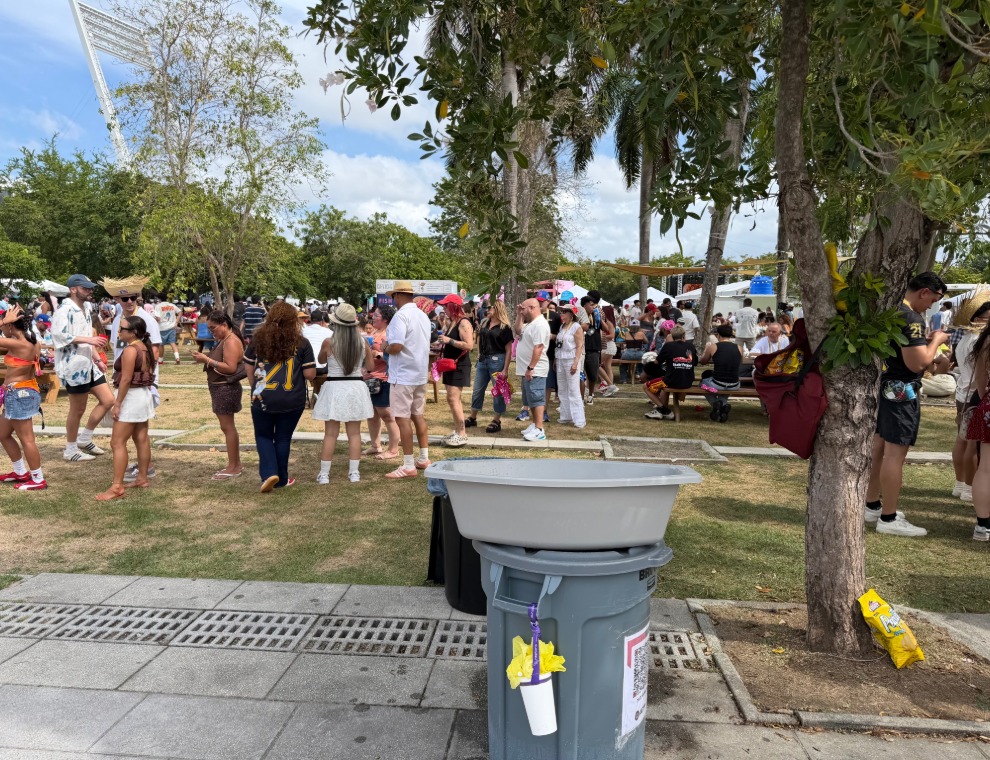
What that actually felt like, physically, is its own story. Case after case of beer, up and down the same stairs, through the same aisles, both nights, until my body started telling me to stop long before either night was actually over. At some point I bought a $7 plastic basin — the same cheap, multi-purpose tub people use at home to wash a baby or a dog, nothing built for stadium work — and used it both days to actually carry cans instead of stacking them in my arms. It’s not an exaggeration to say it saved me. Seven dollars, and it did more work than almost anything else I brought with me.
I worked near the same woman from Hawker Base both nights — the one who’d given the guard grief for not knowing where Base was. She was tough through the entire process, all business, not much patience for anyone slowing her down. By the end of the second night, though, she was warm enough to give me a hug goodbye. That arc is basically what the job was: rough at first, real by the end.
A hawker is one thread in something much bigger. Underneath every concert this size is a small city’s worth of labor the audience never notices: concession workers, bartenders, security at every gate, cleaning crews working between sets, production crews running lighting and rigging — including whoever got that flag up on its crane — technical staff, supervisors on radios, credential and check-in personnel like the man at Hawker Base.
None of it is visible from a seat. From a seat, the show looks effortless — lights up, music starts, a drink appears, the crowd moves like it knows where it’s going. That’s the whole point of the illusion. It’s also the thing you stop being able to see once you’ve spent a night inside the operation that builds it.
Working inside the Bithorn meant experiencing the stadium differently than almost anyone else there. A person in a seat has one vantage point for the whole show. A hawker doesn’t get that luxury, or that stillness.
The nights were motion — up a stairway, down a packed aisle, through a corridor every concourse starts to resemble, back toward base, then out into the crowd again. You see the stadium in pieces: a railing here, a stretch of stairs there, a glimpse of the stage from an angle no ticket would get you, gone again as the aisle carries you on.
It’s a strange way to watch a show you’re technically inside of — fragments between rows and shoulders, never the whole thing at once. But that fragmented, on-your-feet vantage point is its own front-row seat — not to the concert, but to everything holding it up.
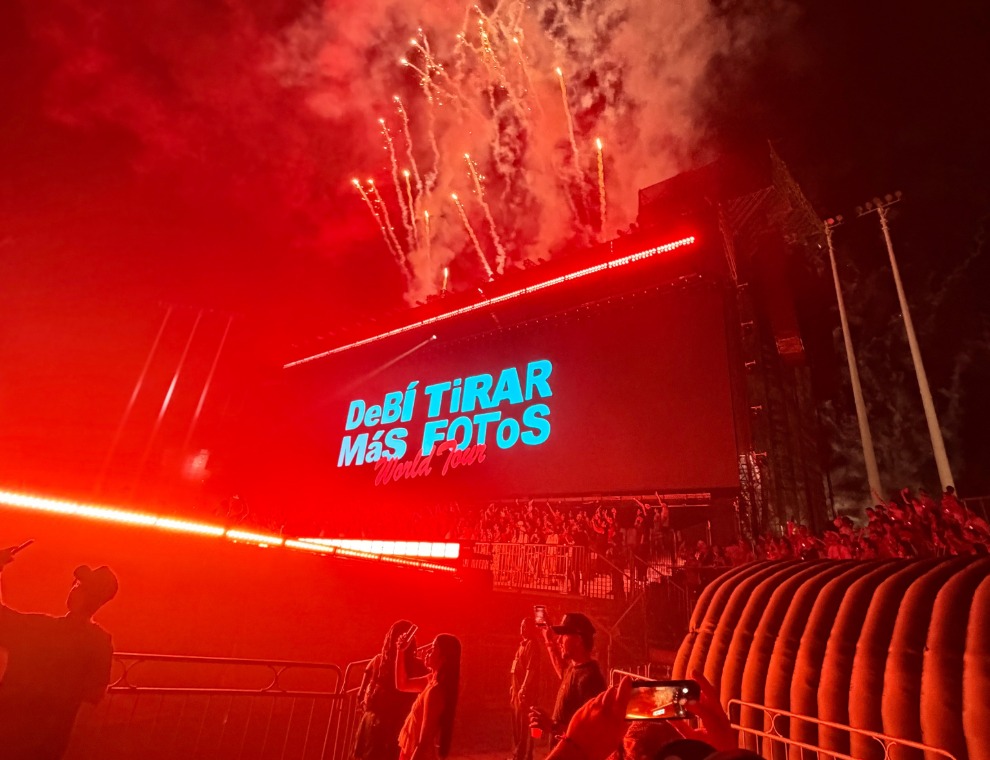
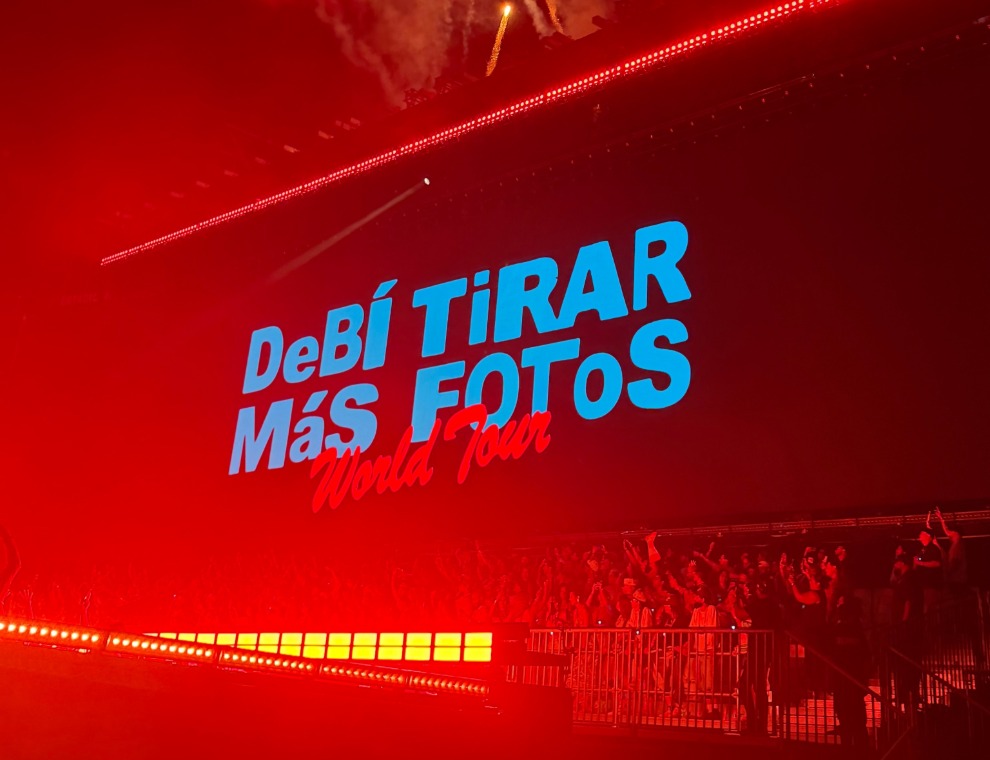
Toward the end of both shows, once part of the crowd had already started for the exits, the production ran fireworks and pyrotechnic effects as part of the closing sequence. To be precise: it wasn’t confetti. A considerable amount of fine powder and residue came down into the area where we were working, landing on workers, on people still in their seats, on me. I didn’t need an engineering report to know how much was falling — I could see it on my new shirt, visibly stained by the end of the night.
I don’t know exactly what the substance was, or whether that amount reaching our section was intentional, or whether we just happened to be standing unusually close. From where I was working, it felt too close. That’s my impression, not a technical finding.
During the first night, I heard other workers talking about VIP bars having to stop service, or close briefly, because residue was landing around exposed drinks. I didn’t see this myself — it’s secondhand, from people working near me. I’m including it because it matches what I did witness: a show, near its climax, physically reaching people who weren’t expecting to be part of the spectacle.
This wasn’t only a cultural event. It was an economic one, documented well beyond anything I saw from the aisles.
An economic-impact analysis by Advantage Business Consulting, presented by San Juan Mayor Miguel A. Romero Lugo, projected the two closing shows would generate roughly $24.4 million in economic activity, support around 273 jobs, and produce a combined $3.3 million fiscal impact for the Commonwealth and the municipality. These are projections, not confirmed totals — the 273 figure covers jobs supported directly, indirectly, and through induced spending, not 273 new permanent positions. Romero’s office estimated the weekend would draw tens of thousands of people across both nights, attendees and employees combined.
None of that is Bad Bunny’s revenue or the production’s profit. It’s what a weekend like this is projected to move through a local economy — and it moves outward in circles: hawkers, bartenders, concession and cleaning crews, production staff; food vendors and restaurants around the stadium; hotels, rideshare and taxi drivers, gas stations, parking; merchandise sellers and local businesses; eventually the municipality and the island itself, through taxes.
My own place in that circle was near the bottom. I’m not going to invent what I personally earned working the aisles those two nights — I don’t have a number worth printing, and it wouldn’t be a large one either way. That’s not a complaint. Standing in the aisles, those projected millions stopped feeling abstract. I could see the economy moving around me. I was just near the bottom of it, doing my small part to keep it moving.
Who Actually Got In?
There was real frustration across Puerto Rico before these shows — locals couldn’t get tickets while visitors and resellers seemed to have no trouble. I don’t think that story is simple, and I’m not in a position to settle it. But here’s what I saw, and what the numbers show.
Tickets went on sale through PR Ticket, priced $80 to $100, exclusive to Banco Popular cardholders. More than a million people reportedly logged onto the platform. Resale listings immediately appeared asking as much as $17,998 for a single ticket, with VIP listings past $6,000. That’s the number that made headlines.
But that wasn’t the whole story. As the weekend arrived, resale prices fell hard — by Sunday morning, hundreds of tickets were reportedly available for $150 to $900. Working the aisles, I heard plenty of customers mention last-minute resale — StubHub came up more than once, prices around $250 for general access near showtime. Conversations I overheard, not verified transactions, but they lined up with what was reported publicly: a resale market that opened at outrageous prices and largely collapsed by the time the gates opened.
As for who was inside: I noticed what seemed like a significant number of tourists and visitors over two nights. I couldn’t tell you a percentage — I wasn’t conducting a demographic survey, I was working. But the crowd didn’t feel strictly local, and that tracks with everything reported about these shows drawing heavy tourism to the island.
Here’s a theory, and I want to be upfront it’s exactly that. What if at least some Puerto Ricans weren’t just displaced by the resale economy, but participating in it — buying at that original $80 to $100 price, watching what visitors and the diaspora were willing to pay, and reselling rather than attending? I can’t prove how often that happened, if it happened at all. But the ticket itself became its own marketplace that weekend, and I don’t think it was made up exclusively of outsiders.
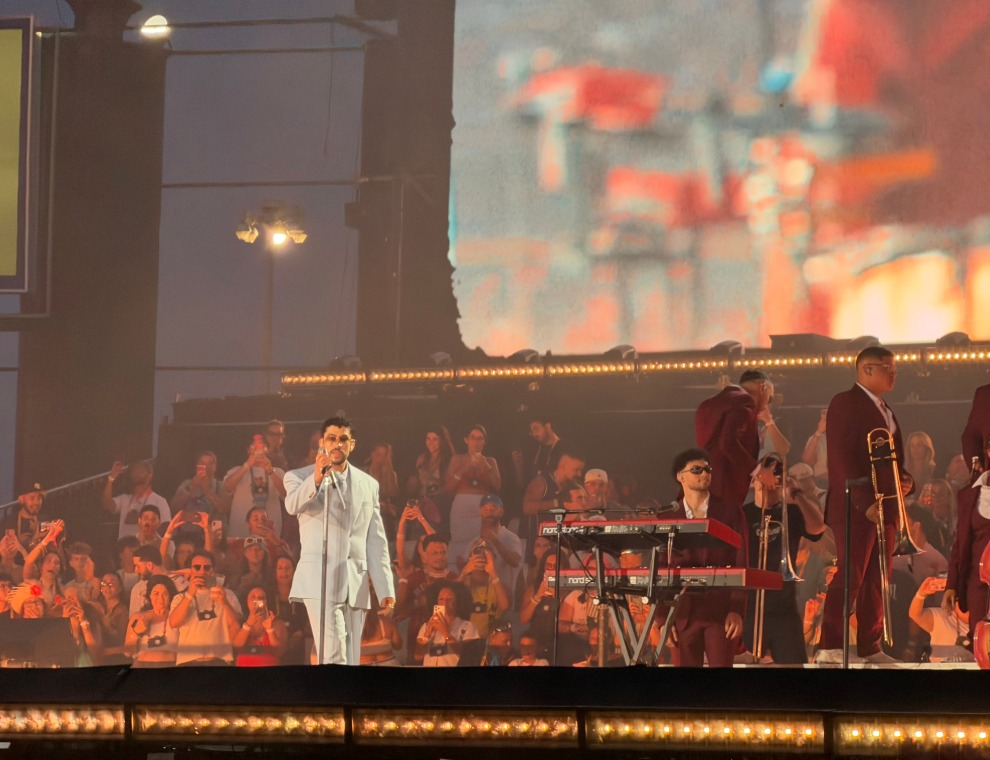
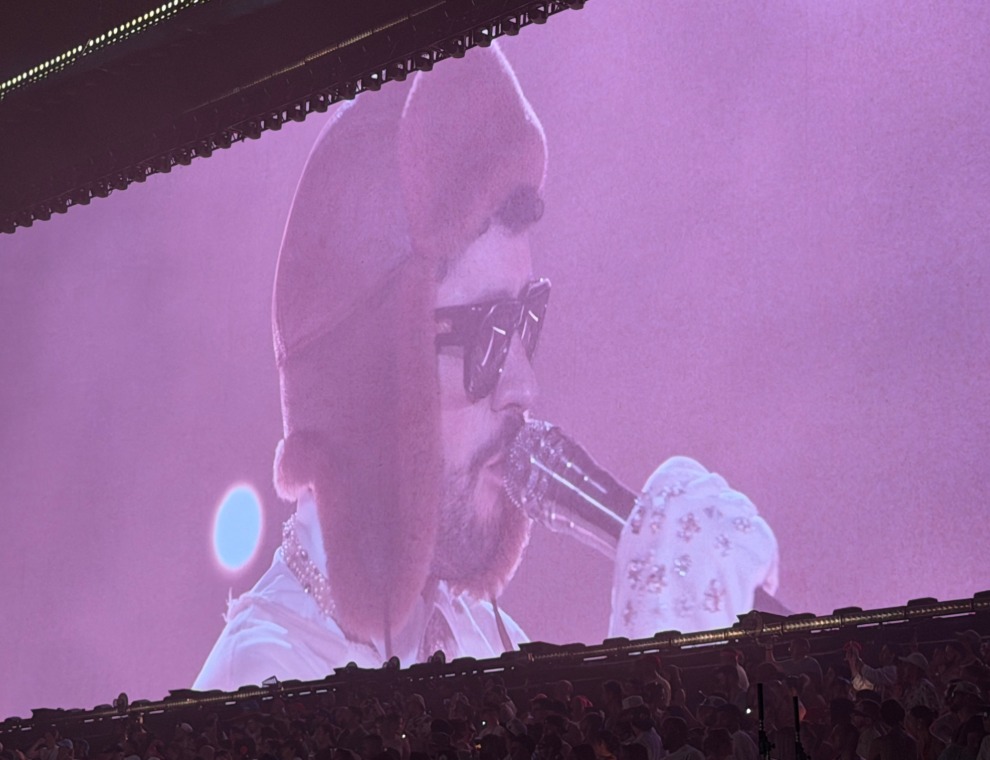
By the time both shows ended, I’d seen two versions of the same weekend. The one everyone came for — Bad Bunny onstage, the flag overhead, a stadium full of people from the island and the diaspora, watching a production built inside a stadium just rebuilt for a different sport entirely. And the one underneath it: a $40 million renovation and a $5 million insurance policy protecting a field under a temporary floor; an outside table that closed the day I was late; a base I had to work to find, and a man who solved my problem in seconds once I got there; residue on my shirt; a ticket market that spiked into the thousands and collapsed by showtime; a projected $24.4 million moving through the city in circles I could feel but not see.
The spectacle everyone remembers is what happened onstage. The story I found was everything — and everyone — that made it possible.
40M
million Hiram Bithorn renovation
5M
$24.4M
TAGS
- Bad Bunny
- Hiram Bithorn
- Puerto Rico
- San Juan
- Behind the Scenes
- Concert Workers
- Puerto Rican Flag
- Concert Economics
© 2026 NYC Weed News. All rights reserved. Original photography and editorial content may not be reproduced, republished, distributed, or used commercially without written permission.
Editorial Disclosure: This article is independent reporting and was not sponsored, reviewed, or approved by a cannabis licensee. NYC Weed News does not sell cannabis and does not receive a commission from cannabis purchases. References to specific businesses are included for news and identification purposes and do not constitute an endorsement. Cannabis is legal in New York only for adults aged 21 and older. Do not drive while impaired.
Image Credits: All images used in this article are licensed through Adobe Stock for editorial use. Images are the property of their respective photographers and are used in accordance with Adobe Stock’s editorial licensing agreement.
© 2026 NYC Weed News. All Rights Reserved. Independent media covering New York cannabis culture, news, and street life.
NYC Weed News is a creative-first independent media group. Our visual content is produced using a range of AI image generation models including MidJourney, Adobe Firefly, DALL·E, and others. We embrace AI as a core part of our creative identity — and we make no apologies for it.
NYC Weed News is an independent media and informational platform focused on cannabis news, culture, mapping, events, and licensed industry resources. We do not sell cannabis products.
All content is intended for adults aged 21+ and is for informational and educational purposes only. No content on this website should be interpreted as medical or legal advice. Always comply with local laws and consult a licensed professional where required.