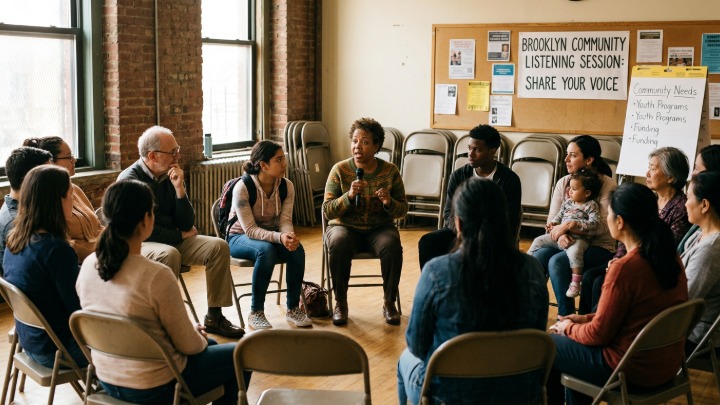
New York State just published something rare in cannabis policy: a government report that actually listened. Over 450 New Yorkers — 308 of them young people — sat down in community centers, cultural organizations, and churches from Brooklyn to Buffalo and talked honestly about what cannabis legalization looks and feels like inside their families. What they said is uncomfortable, important, and largely being ignored by the mainstream conversation about New York’s legal market.
THE REPORT
The State Listened. Here’s What New York Families Actually Said.
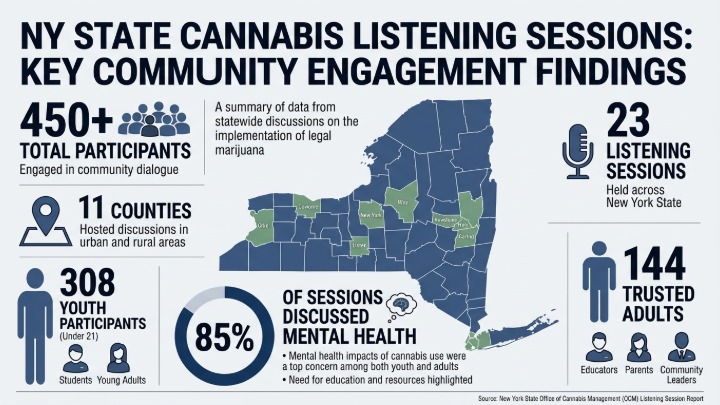
Released May 27, 2026, the OCM Listen & Learn Report is the result of 23 community listening sessions across 11 counties — from the Bronx to Buffalo, from Albany to Staten Island. The Office of Cannabis Management partnered with 19 community-based organizations to create spaces where real families could speak without a script. What came out of those rooms is a portrait of a city and state navigating a massive cultural shift in real time, without nearly enough support.
This isn’t a report about dispensary licensing or tax revenue. It’s about what happens inside homes, schools, and neighborhoods when cannabis goes from illegal to everywhere — and what families are left to figure out on their own.
450+
New Yorkers participated across 23 community listening sessions
85%
of youth discussions raised mental health as the central theme
1 in 10
trusted adults felt confident in what they said when talking to kids about cannabis
📄 Source: OCM Listen & Learn Report, May 2026 · New York State Office of Cannabis Management · 23 sessions · 11 counties · 308 youth · 144 trusted adults · nycweednews.com analysis and commentary
THE KIDS
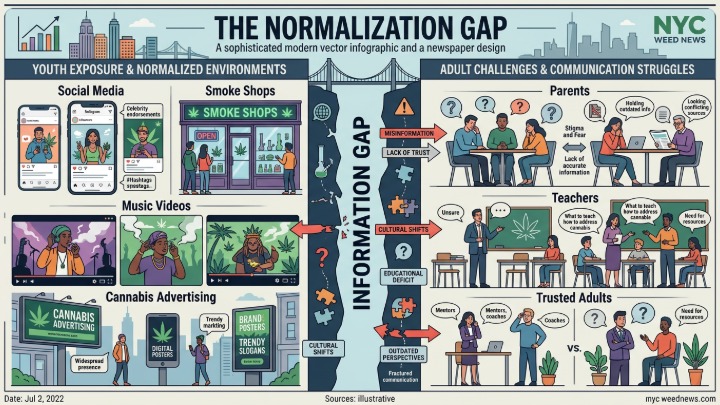
The first finding hits hard: many New York children first heard about cannabis before middle school — some as young as six years old. Not from a parent. Not from a teacher. From their neighborhood. From music videos. From a family gathering. From walking past a smoke shop on the way to school.
This is the normalization gap. Cannabis is now visible everywhere in New York — on storefronts, on social media, in the air outside apartment buildings. But the conversations that should accompany that visibility? They’re happening years later, if at all. By the time a parent sits down to talk to their kid about cannabis, the kid has already formed opinions, absorbed misinformation, and probably already knows someone who uses.
"I don't really know what's legal. Some people say 18, some say 21, some say you can do it if your parents let you."
— Youth participant, The Bronx
"You can get it from someone's older brother or cousin, no problem."
— Youth participant, Albany
"My mom provides it because she's worried about it being laced."
— Youth participant, Albany
About one-third of youth discussions guessed the legal age incorrectly — with answers ranging from 16 to 25. Some thought it was legal “for anyone once you’re out of school.” This is not a failure of intelligence. It’s a failure of education delivery. The state legalized cannabis in 2021. It’s now 2026. And a significant portion of New York’s young people still don’t know the basic legal facts.
The normalization of cannabis has outpaced the normalization of the conversation about cannabis. Kids are absorbing unfiltered information from social media, peer networks, and street-level visibility — and the adults in their lives are largely not equipped to counter or contextualize it.
— NYC Weed News editorial
MENTAL HEALTH
85% of youth discussions in the report raised mental health as a central theme. That number is not a coincidence. New York’s young people are connecting cannabis directly to stress, anxiety, trauma, and the absence of other support systems. Some said cannabis helps people “take the edge off.” Others said they’ve seen it make mental health worse — paranoia, panic attacks, disconnection.
What runs through all of it is a generation that is carrying an enormous amount and has very few places to put it. “Kids are going through a lot,” said one Albany youth participant. That quiet statement contains a library.
"Sometimes adults just shut it down instead of explaining."
— Youth participant, Buffalo
"It feels like you get in trouble just for asking."
— Youth participant, Rochester
"You can't talk to parents nowadays. They come home from work and they're mad."
— Youth participant, Albany
Only one in four youth discussions felt truly comfortable starting a cannabis conversation with a trusted adult. Not because they don’t trust their parents — 60% named parents as their most trusted source of information. But because the experience of asking has too often ended in shutdown, deflection, or punishment. When a teenager asks a question about cannabis and the adult’s response is “don’t do it” or “we’re not talking about that” — the question doesn’t go away. It just gets answered somewhere else.
Our Take
The mental health dimension of this report is the part the cannabis industry doesn’t want to sit with. The legal market talks about wellness and relaxation and creative flow. That’s a real part of the cannabis experience for adults who use intentionally. But the report is telling us that young people in New York are reaching for cannabis as a coping mechanism for anxiety, trauma, and loneliness — and that the adults around them feel powerless to address it.
This isn’t an argument against legalization. It’s an argument that legalization without education, mental health resources, and genuine family support systems is incomplete policy. New York built a market. Now it has to build the infrastructure that actually protects the people living inside it.
This article is part of a three-part series on the OCM Listen & Learn Report and what it means for New York families. All quotes are sourced directly from the official OCM Listen & Learn Report, published May 27, 2026. NYC Weed News analysis and commentary represents our independent editorial position. © 2026 NYC Weed News. All Rights Reserved.