By NYC Weed News
Let’s keep it real for a second. We’re living in the golden age of cannabis. You can walk into a store in NYC, Boston, or LA and buy top-shelf flower without looking over your shoulder. But there is one place where the “Green Wave” hits a brick wall: 30,000 feet.
Last week, JetBlue Flight 1191 left Boston only to pull a sudden U-turn and declare an emergency. The reason wasn’t an engine failure or a bird strike. It was a passenger who decided the airplane bathroom was the perfect spot for a mid-flight sesh.
At first, you hear that and think, “Okay, the guy’s an idiot, but turning the whole plane around? Isn’t that overkill?”
Actually, no. Once you peel back the curtain on how aviation law works, you realize the crew didn’t have a choice. This wasn’t just about a rule-breaker; it was about the pilots and flight attendants fighting to save their careers.
Here is the deep dive on what went down and why the skies are still a zero-tolerance zone.
The “Disturbance” at Altitude
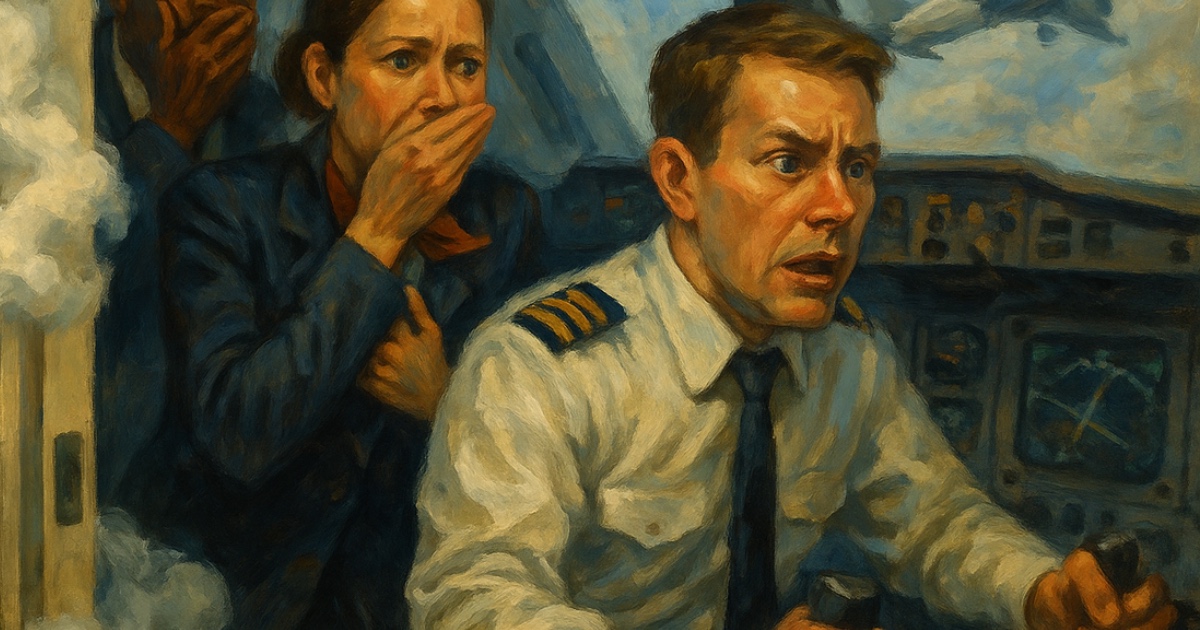
The flight had just climbed out of Boston, heavy with fuel and passengers. Everything was smooth until the pilots keyed the mic to Air Traffic Control. They requested vectors to return to Boston immediately due to a “customer disturbance.”
In pilot-speak, that usually means a fight, a medical crisis, or a drunk passenger getting aggressive. But as the details came out, the reality was dumber: someone was smoking weed in the lavatory.
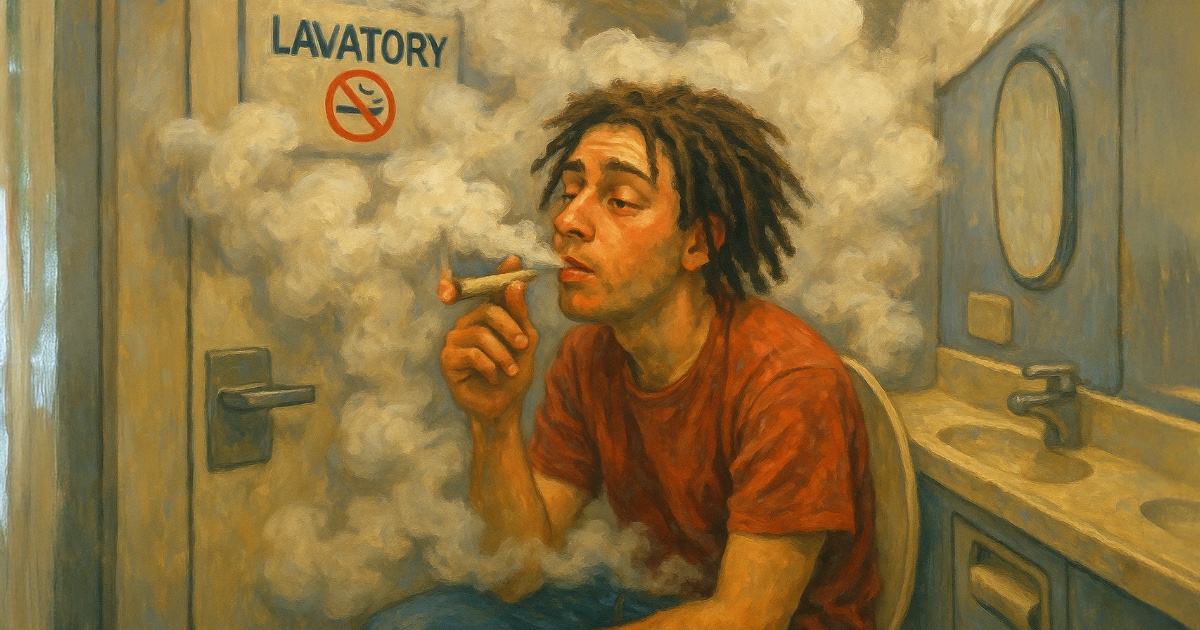
And we aren’t talking about a discreet little vape pen hit (which is still illegal, by the way). This passenger smoked enough that when the flight attendants opened the door, a cloud of marijuana smoke spilled out into the cabin.
That specific moment—the smoke hitting the cabin—is what triggered the emergency.
Why the Crew Really Panicked (It’s Not What You Think)
Most people think the airline is just being the “fun police.” But the reality is strictly business.
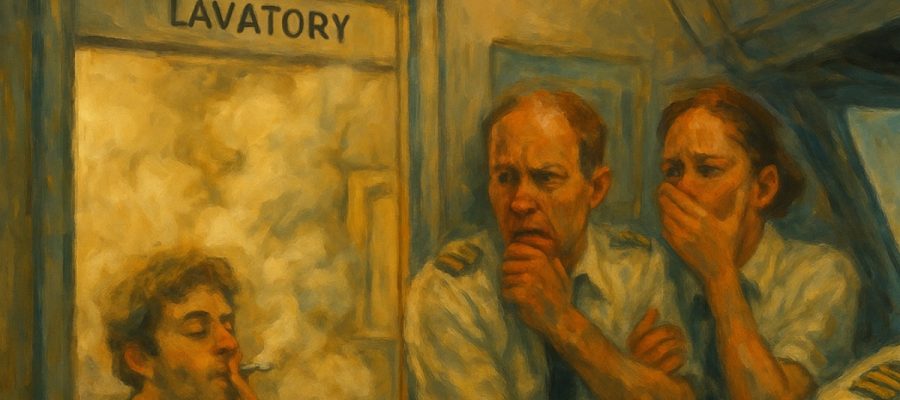
When that lavatory door opened, the flight attendants and potentially the pilots were exposed to second-hand marijuana smoke. In the aviation industry, your body is your license. Crews are subject to strict, random, and post-incident federal drug testing.
If a flight attendant or pilot tests positive for THC, it doesn’t matter if they say, “It was a passenger!” or “I just inhaled it when I opened the door!” The FAA (Federal Aviation Administration) operates with zero chill.
A positive test = License revoked.
License revoked = Career over.
The crew on Flight 1191 didn’t turn around to punish the guy. They turned around to protect themselves. They needed to get on the ground, hand the passenger over to the cops, and document exactly what happened so that when they (likely) get drug tested, they have a police report backing up their story.
The “Overweight” Danger
This is where the smoker’s selfishness actually put lives at risk.
Planes have a Maximum Takeoff Weight (which is high, because they are full of fuel) and a Maximum Landing Weight (which is lower, because they usually burn that fuel off during the trip).
Because Flight 1191 had just taken off, it was way too heavy to land safely. The pilots had to report that they would be making an “Overweight Landing.”
The Risk: Landing heavy puts massive stress on the gear. Brakes can overheat and catch fire. Tires can explode.
The Response: That is why the pilots declared an emergency. It ensures fire trucks and rescue crews are chasing the plane down the runway the second it touches down.
All that chaos, all those resources, and all that danger—just because one person couldn’t wait to land.
The “Bad Joke” Rule: A Cautionary Tale
To understand how serious aviation professionals take this stuff, look at another story from the video source.
A Captain shared a story about a passenger boarding a plane who looked at the pilot and joked, “Hope you haven’t been drinking! Seen a lot of drunk pilots in the news lately.”
To the passenger, it was a cheeky joke. To the pilot, it was an accusation. The Captain couldn’t just laugh it off. Because other people heard it, if he flew that plane and anything went wrong, that comment would come up in the investigation.
The result? The Captain had the passenger removed from the flight. Then, the Captain removed himself from the flight to go get an immediate drug and alcohol test to clear his record. The flight was delayed, the passenger was banned, and the pilot lost a day of work.
If a joke about intoxication can ground a pilot, imagine what actual marijuana smoke does.
✈️ Final: The NYC Weed News Bottom Line: Federal Compliance Required
We are committed to providing our readers with factual, trustworthy information regarding cannabis law and culture. Regarding air travel, the facts are clear:
The Federal Reality
Federal Jurisdiction: Upon entering the aircraft, you are operating entirely within federal jurisdiction. State-legal status for cannabis (including possession and consumption) is immediately superseded by federal law, which classifies cannabis as a Schedule I controlled substance.
Zero-Tolerance Policy: Consumption of any form of cannabis, including smoking, vaping, or edibles, is strictly prohibited by federal regulation (FAA/TSA) on all commercial flights within U.S. airspace.
Compliance and Risk
Violation of Air Safety: The introduction of smoke or vapor into a pressurized aircraft cabin is a violation of federal regulations. It poses a risk to the air circulation system, triggers mandatory detection equipment (such as smoke detectors in lavatories), and compromises the right of fellow passengers to clean air.
Severe Consequences: Non-compliance with federal law regarding consumption or possession on an aircraft is a serious violation. Passengers who disregard crew instructions and federal regulations face immediate detainment upon landing, substantial civil fines (up to $4,000 for smoking violations alone), and the potential for federal criminal charges, which carry fines and imprisonment.
Respecting Crew Authority: Flight crew members operate under federal authority to ensure the safety of the aircraft. Interfering with their duties or creating a hazard due to prohibited consumption is grounds for immediate reporting and arrest.
Final Conclusion: The passenger on Flight 1191 who was arrested upon landing faced significant federal charges. Do not put your freedom and your travel future at risk. The only safe and compliant course of action is to abstain from cannabis and ensure your compliance with all federal laws and crew safety regulations.