By NYC Weed News | March 2026
From Bristol back alleys to Manhattan rooftops — after 30 years, Banksy finally has a name.
For three decades, the most famous artist on the planet refused to show his face. No interviews, no red carpets, no Instagram selfies. Just a spray can, a stencil, and a message sharp enough to cut through whatever wall it landed on. The world called him Banksy. The law called him a vandal. Collectors called him priceless. And until two weeks ago, nobody could prove who he actually was. On March 13, 2026, the mask finally came off.
Bristol. A Rough Street. A Kid With a Can.
The Barton Hill district in Bristol, England, in the 1980s was a rough part of town — working-class, run-down, and unwelcoming to outsiders. That’s exactly where a young kid from a leafier part of the city decided to make his first foray into graffiti. He was trying out names at the time, sometimes signing himself “Robin Banx” — a tag that soon evolved into Banksy. Shorter, more memorable, and easier to write fast on a wall.
According to art historians and biographers who have traced his early career, he started as a freehand graffiti artist between 1990 and 1994, running with Bristol’s DryBreadZ Crew — known as DBZ — alongside two other artists called Kato and Tes. His work was deeply rooted in the Bristol underground scene, a world where art, music, and rebellion ran together. It was there that he first crossed paths with Robert Del Naja — known as 3D, later a founding member of Massive Attack — an encounter that would fuel years of conspiracy theories about who Banksy really was.
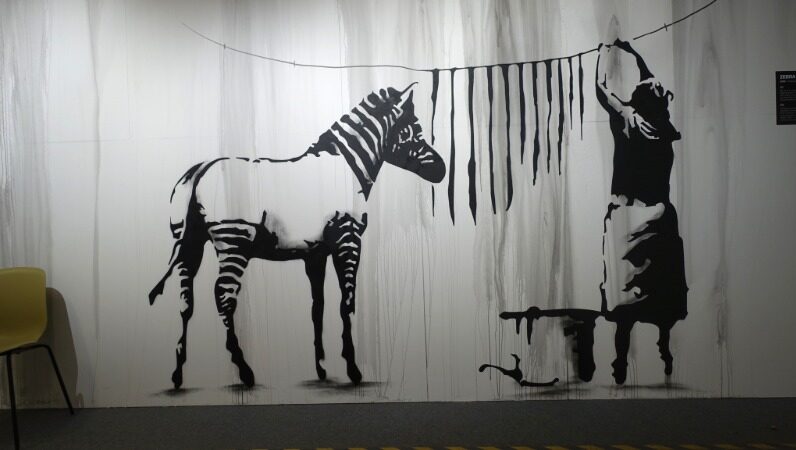
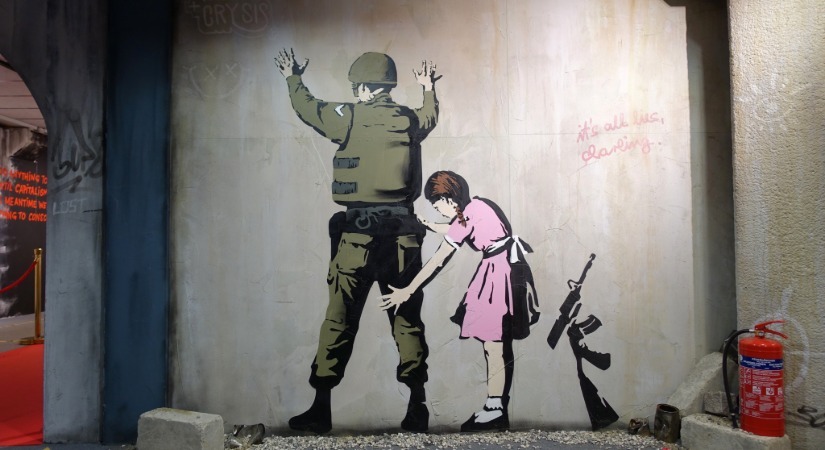
The stencil technique that would make him famous came to him by accident. As reported by multiple outlets over the years, by 2000 he had switched away from freehand work after realizing how much less time it took. His own account: he was hiding from police under a garbage truck when he noticed the stenciled serial number on the vehicle and had an idea. Speed was survival. A stencil could be pressed and pulled in seconds. Freehand could get you caught.
“As soon as I cut my first stencil I could feel the power there. All graffiti is low-level dissent, but stencils have an extra history. They’ve been used to start revolutions and to stop wars.”
— BANKSY

The Ally Who Helped Build the Brand
No artist builds a global reputation alone — and Banksy was no different. In the 1990s he met Bristol photographer Steve Lazarides, who began photographing his work and eventually became his manager and agent. Lazarides would later describe first meeting “this scruffy, grumpy guy” with zero expectation that he’d become the most discussed artist of his generation.
But it wasn’t just Lazarides who shaped Banksy’s path. His relationship with Shepard Fairey — the Los Angeles street artist behind the iconic Obama “HOPE” poster and the OBEY campaign — became one of the defining creative connections in street art history. As documented in Banksy’s 2010 Oscar-nominated documentary Exit Through the Gift Shop, it was Fairey who first introduced Banksy to the film’s central subject, Thierry Guetta, when Banksy needed a local guide during a 2006 LA visit. The two also painted together in person, collaborating at a warehouse exhibition in Sydney in 2003.
The mutual respect ran deep. Banksy once made his admiration for Fairey plain, saying: “If Shepard Fairey comes to your town, every single graffiti writer gets uptight… I am absolutely positive he has made more reaches than any graffiti writer in history ever has done or ever will. And that means he’s won.” Two artists from opposite sides of the Atlantic, both using public walls to say what institutions wouldn’t — they understood each other completely.
From the Walls of Bristol to the Walls of the World
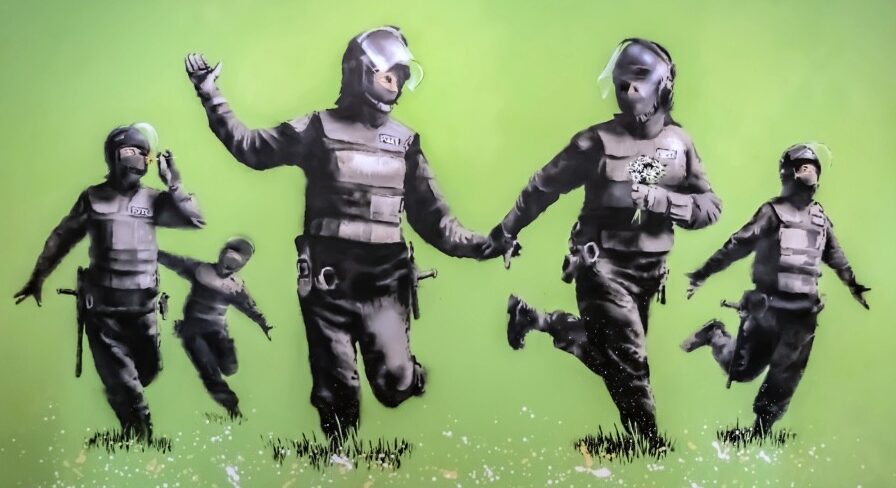
By the early 2000s, Banksy had outgrown Bristol. He relocated to London, then began hitting cities worldwide — New York, Los Angeles, Paris, Vienna, Barcelona, New Orleans, and eventually the West Bank in Palestine, where he painted directly onto the separation wall. Those nine images on the West Bank Wall — including the now-iconic Love Is in the Air — were an instant phenomenon and exploded online, marking his dramatic entry into the global consciousness.
The art world, which had long dismissed graffiti as vandalism, started paying serious attention — and serious money. As reported by Reuters, in February 2007, Sotheby’s auctioned three of his works in a single night, with Bombing Middle England fetching over £102,000 — well above its estimate. The establishment was buying the work of a man who considered the establishment the enemy.
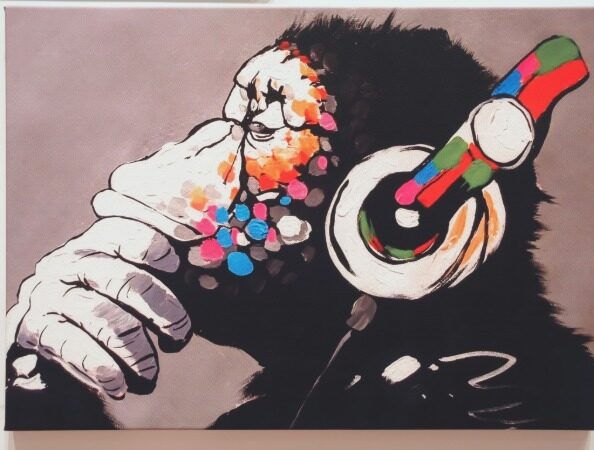
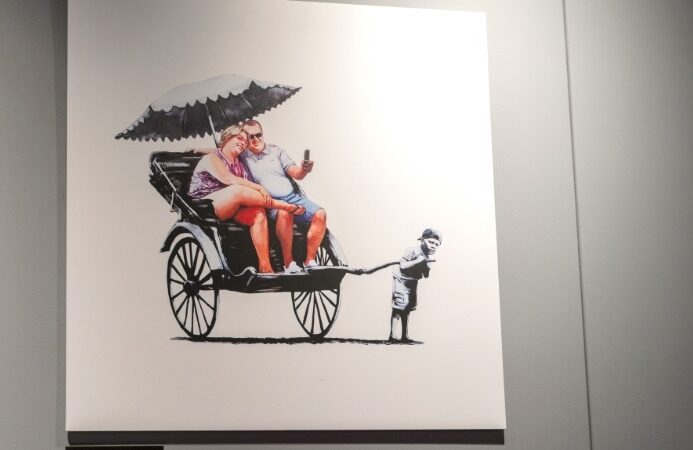
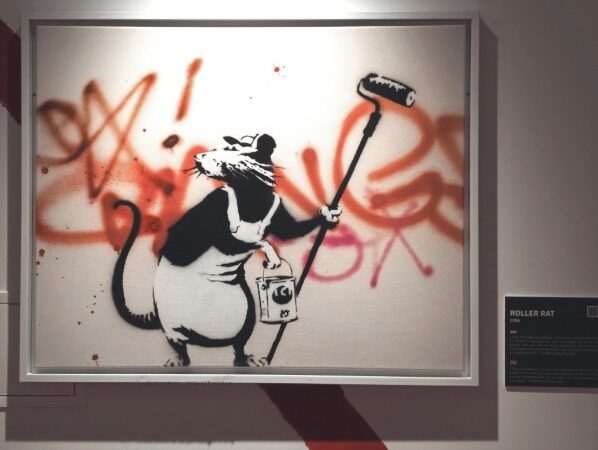
When Time magazine put Banksy on its list of the world’s 100 most influential people in 2010 — alongside Barack Obama, Steve Jobs, and Lady Gaga — he supplied a photo of himself wearing a paper bag over his head. Recyclable, naturally.
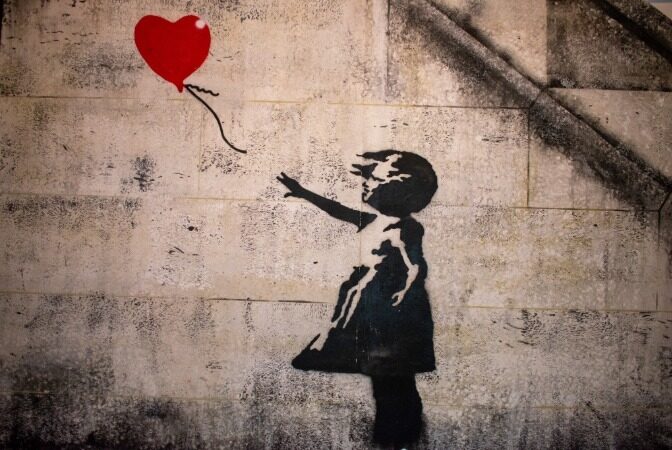
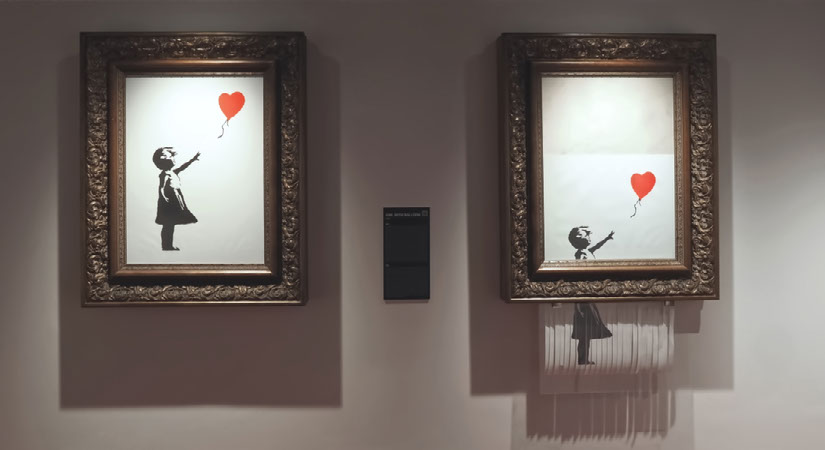
Then came the moment that defined him for a generation. In October 2018, at a Sotheby’s auction in London, his Girl with Balloon sold for £1.4 million — and immediately began shredding itself through a hidden mechanism built into the frame years earlier. Rather than destroying its value, the stunt supercharged it. As reported by The Art Newspaper, the partially shredded work, renamed Love Is in the Bin, resold in 2021 for approximately $25 million. Banksy had trolled the art market into making him richer than ever. The joke was on everyone, and everyone loved it.
“The urge to destroy is also a creative urge.”
— BANKSY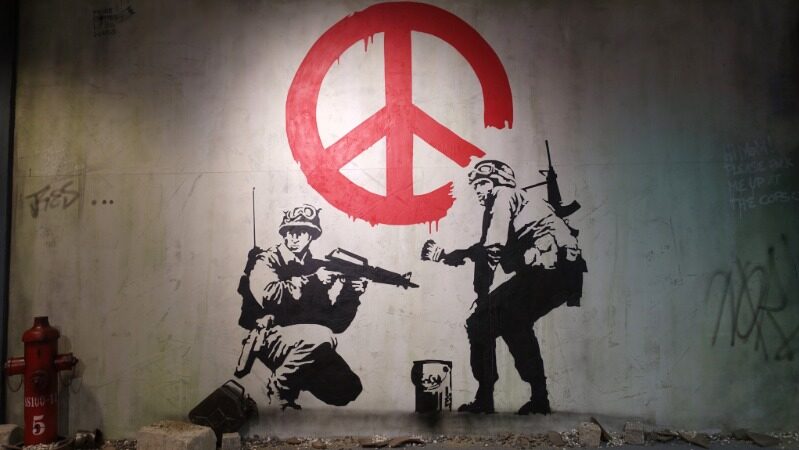
New York: The City That Called to Him
If Bristol made Banksy and London launched him, New York was where he proved himself. In October 2013, Banksy took over New York City for an entire month — pledging to create a new piece of art every single day of his residency. As reported by the Village Voice at the time, he said: “The plan is to live here, react to things, see the sights — and paint on them.”
But his connection to New York started much earlier — and much more dangerously. According to Reuters, on September 18, 2000, NYPD officers caught a man defacing a Marc Jacobs fashion billboard on the rooftop of 675 Hudson Street in Manhattan’s Meatpacking District. The man signed a handwritten confession. His name: Robin Gunningham. The cops had no idea they’d just booked the future king of street art. He paid a $310 fine and completed five days of community service. That confession, buried in a court file for 25 years, would become the document that changed everything.
The Unmasking: March 13, 2026
On March 13, 2026, Reuters published an explosive investigation identifying Banksy as Robin Gunningham — a 52-year-old Bristol native — based on previously unreported police documents, court records, and immigration files traced across New York, London, and war-torn Ukraine.
The trail started in Horenka, a village near Kyiv, where Reuters journalists interviewed local residents who had witnessed Banksy painting murals there in late 2022. The investigation confirmed that a “David Jones” — the name Gunningham had legally changed to around 2008, chosen because it’s one of the most common names in Britain, almost designed for invisibility — had crossed into Ukraine on the exact date matching the murals.
According to Reuters, Banksy’s lawyer Mark Stephens responded by stating the artist “does not accept that many of the details contained within your enquiry are correct,” arguing that unmasking would violate his privacy, interfere with his work, and put him in personal danger. Banksy’s own company, Pest Control, said simply that he “has decided to say nothing.”
The art world split immediately. A 2008 report from The Mail on Sunday had already linked Gunningham’s name to Banksy — and art consultant Nico Epstein captured the feeling many fans had: “I wanted the memory of the anonymous artist — and the mystery behind that — to live on. Banksy is a superhero for many, many people. People want to believe that fairy tale.”
“I wanted the memory of the anonymous artist to live on. Banksy is a superhero for many, many people.”
— NICO EPSTEIN, ART CONSULTANT
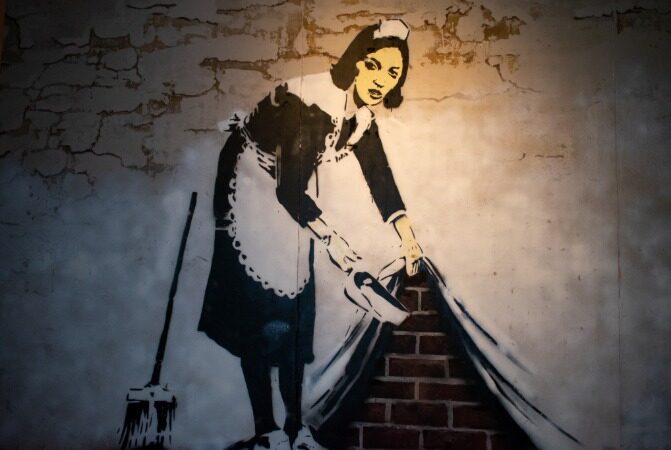
What Happens Now?
The question the art world is asking: does it matter? According to Epstein, the bigger question is whether Banksy will still be able to make interesting work now that he’s been uncovered — predicting that it will be more difficult and that there may be a decline in both output and financial value.
But Banksy has defied every prediction made about him for 30 years. He was supposed to be just a vandal. Then just a fad. Then just a meme. Each time, he came back sharper. His most recent pieces — murals in Ukraine in 2022 and a provocative work outside the Royal Courts of Justice in London in September 2025 — continued to generate international headlines and cultural controversy long before Reuters printed a single word about Robin Gunningham.
The walls don’t care what his name is. Neither, probably, does he.
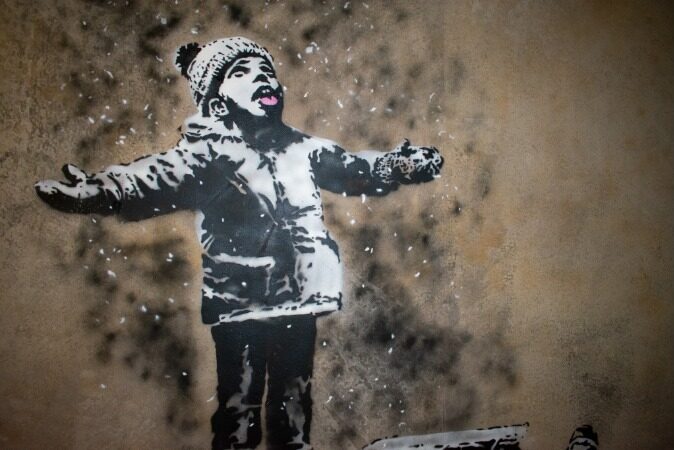
5Pointz: The Night They Whitewashed New York’s Greatest Graffiti Mecca
The full story of Long Island City’s legendary walls, the artists who built them, the developer who destroyed them, and the $6.75 million court ruling that changed street art law forever.
Affiliate Disclosure: NYC Weed News participates in the Amazon Associates program. If you purchase through our link above, we may earn a small commission at no extra cost to you. We only recommend books we genuinely think you’ll find valuable.